One Giant Leap for Sol-kind

This morning, we packed up a small 3 bedroom condo in beautiful Belleair Beach, Florida, buckled the kids into the car, and headed into our final day of Therasuit Intensive Therapy at Lamperts Therapy Group. For the past three weeks, Solly has been working his tail off three hours a day, five days a week. Therasuit is very similar to the intensive therapy we did back in July, except this round was much longer, much more intense, and very regimented.

​Every day, therapy began at exactly 9am. For the first hour, Solly started out laying on a table, where Gina, his physical therapist, would apply heating pads to his legs and hips. She’d stretch out each limb, paying super close attention to his legs, hips, and right arm since that’s where he tends to get the tightest. She would then move Solly through a series of table exercises where she’d attach a small weight via a pulley system to his leg or arm and, by lightly tapping him, encourage him to move his limb in a certain way. 
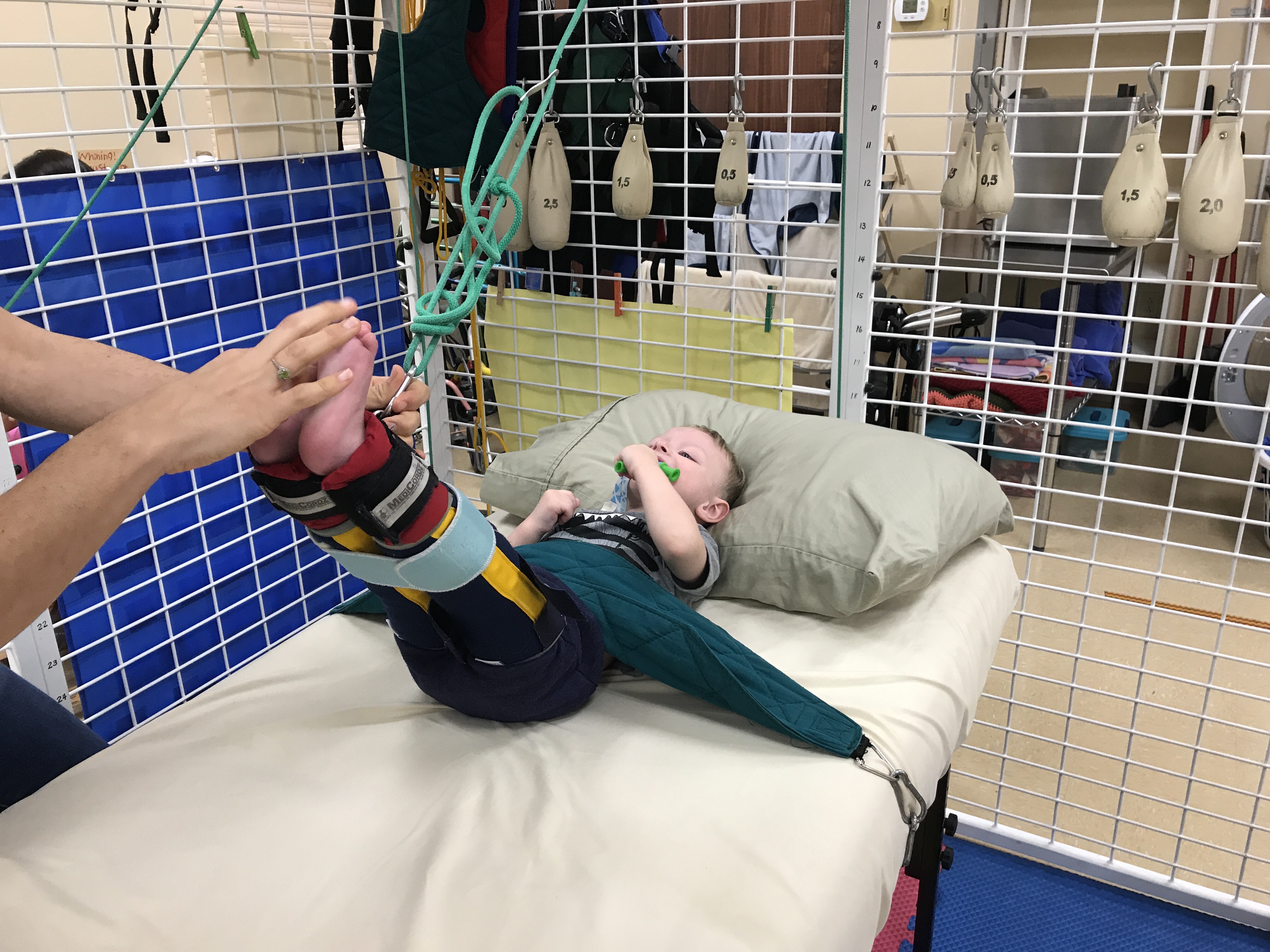
Workin’ those glutes!


After his stretching and lifting exercises, Solly would either work on walking or on core and arm strength for the remaining two hours. Both of these activities were done with Sol wearing a therasuit, which is a compression garment and a series of rubber strips placed to bring awareness to specific areas of the body. For core and arm strength, she’d move him to the floor to work through sitting, side sitting, tall kneeling, quad position, or sit-to-stands. Walking was done either in a gait trainer or on the treadmill.

Hands and knees – not our favorite


The entire three hour session was tiring for Sol. We made sure to take several breaks for hugs and snacks, but, in true Solly fashion, much of the session was completed with a smile on his face. 
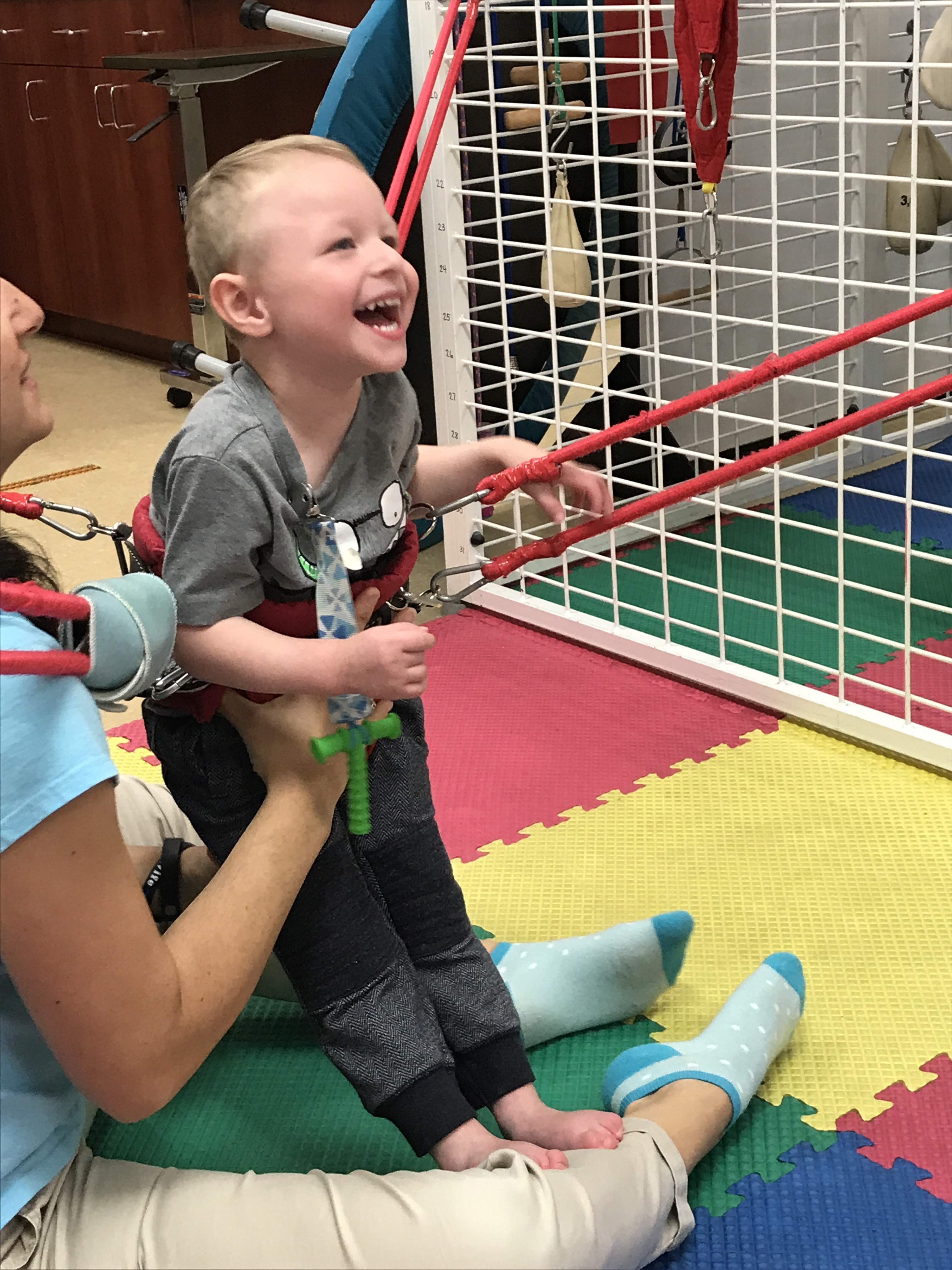
Jumping!


Results from this intensive therapy can continue to be seen for weeks after completion, but here’s what we noticed so far:

  • Perhaps most excitingly, Solly took his first-ever unassisted steps in a gait trainer!
  • When Sol walks, his legs tend to scissor due to high tone. Part of teaching him how to walk includes proper foot placement to avoid scissoring. Over the final days of the therapy, it seemed that he became much more aware of where his body is in space. We noticed that his foot placement improved drastically, so much so that he could keep his legs from scissoring while walking in the gait trainer.
  • Improved core strength altogether, including arms!
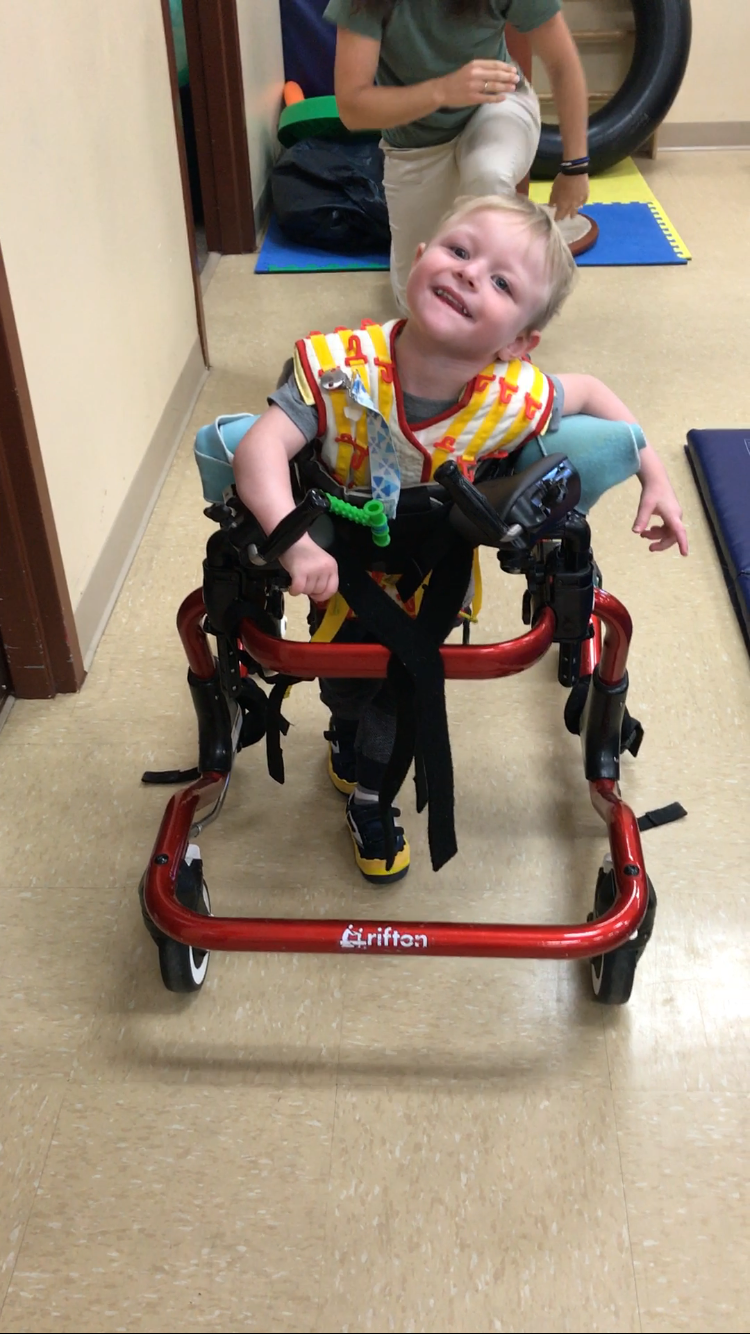
First unassisted steps in a gait trainer


While these gains may seem like itsy bitsy baby steps, being able to walk in a gait trainer on his own is a HUGE gain towards independence. We’re excited to head home, continue the home program that Gina prepared for us, and allow Solly to spend more time in the gait trainer. We hope this will be the first step to him really taking off with walking!

Sweet Bea

For some time, I’ve wanted to write something about having a baby after a having perinatal stroke survivor, but even nine months after having Solly’s little sister, I am still struggling to wrap my mind around the experience and put it into words. Deciding to try and get pregnant after having Solly was just one hurdle: the nine months that followed was a long stretch of managing self-blame, worry, and anxiety while trying to relax and “enjoy” the pregnancy. Oh, and on top of that, I was still taking Solomon to endless appointments, researching treatments for him, and planning alternative therapies for the year.

After Solly was born, I couldn’t imagine having another child. Even though I knew that nothing I did caused his strokes, I couldn’t help but blame myself for what happened to him at birth. My body was supposed to keep him safe, but instead it let something awful happen to him. How the heck could I risk this happening again?

But, as Solly began to grow and thrive, Mike and I knew that we wanted to add more love to our family and we decided to rely on faith and medicine to try and give him a sibling as quickly as possible. After interviewing several OB/GYNs (mad love to my sister for connecting us with the right one) and having extensive tests run which found that I have multiple clotting disorders, we were on our way to baby number two in a high-risk pregnancy. I was on extra plant-based folate, a daily baby aspirin, and a daily shot of Lovenox, all steps to reverse any potential clots. At first, we saw the doctor every four weeks, then after 20 weeks, it was every two weeks, and then at 33 weeks, we were seen twice a week with ultrasounds each time to make sure the baby was still growing. I had a lot of great support, especially from other Moms who’d had a baby after a stroke survivor, however at each appointment, I was convinced the doctor would find something wrong or wouldn’t be able to find a heartbeat. (I think Beatrix caught wind of my anxiety, because during an ultrasound at 14 weeks, she threw her hand above her head and gave us a thumbs up.)

For the two months leading up to Bea’s birth, I basically lived in a yoga studio, attending several prenatal yoga classes each week because it was the only time my mind could relax and I felt like I could connect with the baby growing in my belly. Aside from the month when Solly was in the NICU, it was the most anxiety-filled time of my life.

At 38 weeks along, we went in for a scheduled cesarean. I pumped myself up: I was ready to have our little girl. I was in great spirits the morning of, despite Solly having kept both Mike and I up most of the night before. I was still in great spirits as we registered for our hospital stay and as the nurse brought us up to the pre-op area and even as the anesthesiologist walked us through possible complications (oh, you know, just possible paralyzation from the mid-back down, nbd) that could arise with the combination of my clotting disorders and the spinal block needed for the c-section.

When the nurses started to ask about Solomon, though, and our birthing experience with our first child, I lost it. I couldn’t stop the tears from flowing. At that point, I realized how much I had been blaming myself for Solly’s strokes and how much I hadn’t dealt with that guilt.

For any Mama reading this who’s struggling while pregnant after having a perinatal stroke survivor, here’s some advice from someone who’s been through the experience:

  1. Find a supportive obstetrician. I cannot stress this enough. Our doctor was calm throughout our pregnancy and never made a big deal over anything, which helped keep my anxiety in check. Before we went back for the cesarean, he prayed with us, which is exactly what I needed in the moment, and he even joked with us a bit during the procedure, which is exactly what I needed in THAT moment. Do your research, interview, and go with the doctor that feels right to you. Don’t settle.
  2. Find emotional support. If you aren’t getting the support you need, find a good therapist to help you sort through your emotions. I didn’t do this until after Bea was born (because only weirdos get therapy, right?) and it’s my one regret of the pregnancy. I think I would have been able to relax and enjoy the pregnancy had I seen a therapist during it.
  3. Get advice from other Mamas who’ve been in your shoes. A Facebook group that was immensely for me was Pregnancy After Perinatal Stroke.
  4. Work it out. Yoga or any other exercise will help keep your mind in a good place.
  5. When it’s time to give birth, tell the hospital staff about your previous experience. Because I broke down when telling the nurses about our birth experience with Sol, they filled in any staff member who would work with us during our hospital stay. There was never any question if I got paranoid about something Bea was doing or not doing and every staff member approached us with lots of compassion.

Despite having nine months full of anxiety and a slight breakdown before giving birth to her, Bea’s birth ended up being easy with no complications. We couldn’t be happier with the bond that’s developing between Solly and Bea and we look forward to watching them help each other grow and thrive.


The Secret Life of Special Needs Moms

Y’all, being a Special Needs Mom is unique. It’s hard. It’s exhausting. It’s rewarding in its own way. It’s special. 

To the outside world, it may seem like we – special needs parents – are steadfast, strong, and unbreakable. We speak up for our kids, we never back down, and we have an infinite amount of patience. But, behind closed doors, we feel weak. We question ourselves. Tears flow easily. We always feel guilty. 

Over the past three years, I have befriended so many Mamas and Dads just like us on Facebook, Instagram, and WordPress, and my feeds are peppered with questions and statements like:

My son is doing this strange thing with his arm. Here’s a video – is it a seizure?

My child hasn’t pooped in days. Is this normal?

He’s not drinking again. Do I take him in?

Well, another trip to the ER. Let’s hope we get to go home tonight.

Just found out my daughter has to have double hip surgery. I’m so nervous!

Doctors are saying my infant son’s head isn’t growing. I’m super paranoid about it and am now measuring it every day. Is this normal?

I’m just so tired and no one seems to support me or understand what I’m going through

This is our norm. It’s what we face every day. It’s our secret little world, one that only special needs parents “get”. Despite what many parents of typical children say, no, our journey is not like theirs. 

Time can make the special needs journey easier. Eventually, you find strength in yourself to stand up to a therapist who doesn’t believe in your child. You change doctors who don’t have the same philosophies as you without feeling guilt. You start seeing your child as your child and not as a diagnosis.

One thing that I have struggled with since day one are stares and comments as we venture out into the public. When Solly was eight months old, I remember feeling hurt when someone commented that they thought he was only 3 or 4 months old because of his gross motor delay. I wrote about another time when a cashier mentioned that Solly reminded her of her grandson who had CP and autism and was institutionalized. As Solly gets older and his disability becomes more obvious, the stares and whispers of strangers are increasing. 

This used to keep me holed up at home. Just the thought of the possibility of an off-color remark about my son turned me into a recluse.  But in the past year, things have started to change. Yes, for many reasons, it’s still difficult for us to get out and enjoy things as typical families would – family gatherings, neighborhood barbecues, trips to the park. But we are starting to enjoy adventures like these in our own way. 

A few weekends ago, we headed out to the Cheekwood Estate and Gardens. They’d recently opened up Cheekwood Harvest, which had been on my list of things to do in Nashville. When we got there, we made a beeline for the pumpkin patch. I pulled Solly out of the stroller and plopped him down on his feet, keeping him steady with my hands. I showed him the pumpkin house, and all the pumpkins in the pumpkin patch – big, little, white, green, orange. As I pointed out all the pumpkins, I slid my hands under his arms and whispered “kick, kick, Solly”. He began taking steps with my support and together we walked the length of the pumpkin patch. I’m sure we got loads of looks and stares – Solly sporting his AFO and SWASH braces among the perfectly dressed toddlers of Nashville, all decked out for their Fall photos. But in that moment, I could have cared less. My son was taking assisted steps and checking out the pumpkins with me. For once, my secret special needs world was not-so-secret anymore and I couldn’t be prouder of it.

Walking through the pumpkin patch

Two Months Post-SPML

This Sunday will mark two months since we made the difficult decision to have Selective Percutaneous Myofascial Lengthening (SPML) surgery. We’ve been hard at work over the past two months, doing some intensive therapy as well as weekly hippotherapy, and, boy, are we seeing some great gains.

For those of you who know Solly personally, you might remember the “old” Solly as a little boy who could not stand or move his legs reciprocally.

This was Solly in April:

Last night, Mike “walked” Solly around the kitchen for a good 20 minutes so Solly could explore, open drawers and cabinets, and see the world from a new height. It was pretty amazing. I was on cloud nine watching Solly move around in ways I never thought would be possible given the level of tightness he had earlier this year.

This is something that we practice every day. We used to try to get Solly in his KidWalk daily before the surgery, but he grew increasingly frustrated in it because he couldn’t move the way he wanted to. Now, he can not only move in it but he enjoys the time he spends walking around in it.

Pretty cool, right?

An Intense Intensive

This week, Solly had his first ever PT intensive at Full Circle Therapy, the center where he does hippotherapy.

It was intense! (Seriously. Solly took a 4 hour nap yesterday!)

Each day started bright and early at 8am, which meant an even earlier wake up call than usual for Sol. Our goal for the week was to increase his mobility, so Jennifer, his PT, focused each day on activities to strengthen his hamstrings, hip flexors, glutes, and all walking muscles, as well as other activities to bring awareness to these parts of his body. She used a combination of weight-lifting via pulleys, a Spider Cage, mechanical horse, treadmill, swing, and therasuit to target his walking muscles and core, quickly moving to a new activity when Solly started to appear “over it” to keep him interested and engaged. She also tried having him walk in his various braces with his KidWalk, a gait trainer, crutches, and with hands under his arms for support, all trying to trigger and activate different muscles and so he wouldn’t get stuck in one pattern.

It was fascinating, exhausting, and, in the end, SUPER productive. We went from Sol really struggling on Monday to engage his flexors to walk forward on the treadmill to him walking on his knees and feet with assistance under his arms on Friday. We have a long way to go, but now we understand that Solly’s issues with walking stem from a motor planning issue – his legs get stuck in extension and his brain has trouble telling them to break up any high tone to bend the knee. Jennifer sent us home with three simple PT activities to focus on over the next few months and, because we see her every week for hippotherapy, she can check in on his progress and help us makes tweaks. We’ll focus on those activities for walking until the end of October, when we travel to Tampa for a 3 week Therasuit intensive.

We are so thankful to have found Jennifer. She is very in tune with Solly’s needs and thinks the sky is the limit for him. We couldn’t agree more.

Here are some photos taken throughout the week:

This slideshow requires JavaScript.

And my favorite video of reciprocal knee walking (!!!):