Whatcha Say

“May I ask what he has?”

I blinked my eyes several times. Did I just hear the Starbucks barista right? Did she just ask me what condition my son has?

“Excuse me?” I said, with a smile.

“What does he have?”

“Oh, Solly? What does he have? You mean …….. He has CP,” I said quietly, nervously. I was hoping that’s what she meant by her question, not wanting to make her feel awkward if it wasn’t.

“Oh, CP! My oldest has Asperger’s. I’m a special needs Mom, too,” she replied. “Bye, bye, Solly. Come back, soon!”

This conversation was such a breath of fresh air that I literally skipped back to the car with my chai tea latte in one hand and Solly in my other arm.


When you have a special needs child, every outing has its share of stares. It used to bother the heck out of me and keep me inside the house. Now, I’m so used to it that I don’t notice, I don’t have time to dwell on it and, quite frankly, I don’t care if a handful of strangers stare at my obviously delayed and different child. However, one of the hardest parts of being a special needs Mom is feeling different and outcast from the general public, and the stares certainly don’t help. The problem, I’ve realized, is that unless you are a special needs family, you simply don’t know what to do or say when you see a child or person who’s a little bit different. And, instead of saying something to that family or child, you might wonder “what’s wrong with that child” and worry about what to say and decide it’s best to say nothing at all.

Continue reading

Just Passin’ Time

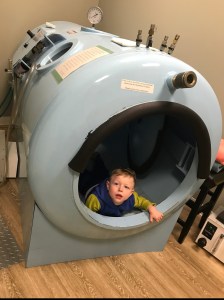
Solly and the HBOT chamber

Solly in his submarine

This morning, Solly and I finished our 5th of 40 dives in our second round of hyperbaric oxygen therapy (HBOT).

As I’ve told folks about this therapy over the past few days, the biggest question I’ve gotten is: how the heck do you pass the time in that chamber? During our first round of treatment, the answer to this question was easy: we were in a sleek, all-glass chamber with a TV on the outside, so we’d watch an hour of Sesame Street or Fixer Upper and our time in the chamber would pass by rather quickly. However, the local facility where we’re doing our second round of HBOT has a very different chamber called the Fortius 420, which looks a bit like a submarine – it’s fairly dark, has three small windows, and no TV (eek!). This difference is, in part, what led to my anxiety before we began our second round of treatment. I kept worrying, “How was I going to entertain a 3-year-old in an enclosed space for over an hour every day….. and stay sane?”

In sum, we spend 75 minutes in the chamber. We “descend” to a pressure of 1.5 atmospheres for about 7 minutes, we are at that depth for 60 minutes, and then we “ascend” for about 7 minutes. We’re allowed to bring a bottle for Solly to drink, a few books, and some approved toys.

Continue reading

What A Ham

After Solly was born, we had a month-long stay at the Georgetown University Hospital’s NICU. There, the neonatologist had told us that in order to be discharged, we had to get Sol’s seizures under control and come up with solutions for his oxygen levels and feeding. Seizures were the easiest thing to get under control, followed by removal of all oxygen support. While we were confident that Sol would come home without any feeding support, some of his doctors were less-than-optimistic. I remember expressing some feeding concerns to one of his rounding doctors, a Fellow who was spending some time at Georgetown, and her exact words to me were: “I don’t think he’ll ever eat by mouth. He may be able to have some pleasure feedings by mouth, but he’ll probably go home with a g-tube.”

Less-than-optimistic, right? It was definitely not the kind of thing we wanted to hear.

Luckily, Solly is stubborn (just like his Mama and Dada!) and proved that doctor wrong, leaving the NICU a little over a week later without any feeding support.

However, since leaving the NICU, feeding has continued to be a struggle for us. Sol’s strokes affected his ability to coordinate muscles, including facial muscles, as well as dampened some of his sensory abilities. At three years old, he is still taking the majority of his calories in by bottle and eating some finger foods, but primarily favoring purées that he can eat by spoon or feed to himself with his fingers. We’ve been in weekly feeding therapy since he was one year old to address his muscular challenges as well as a few behavior issues. Progress has been slow, but entirely worth it, especially after we switched to a new, very experienced feeding therapist, Linda, at High Hopes in Franklin, TN.

Continue reading

The Right Kind of Support

Before I had Solly in my life, social media was a place to simply share photos, articles, humblebrag, and occasionally whine. Back then, even though I was working in digital marketing, I felt myself growing increasingly annoyed with all the oversharing on all platforms and was particularly ready to pull the plug on Facebook (hello, addiction!).

Then, I had a special needs child. Because of HIPPA, our doctors and therapists couldn’t connect me with other parents going through a similar journey. I connected with a few parents while in waiting rooms, but their child’s diagnosis wasn’t always the same, so I still had questions and craved advice from parents who had been there, done that. So, I started googling and realized how many special needs parents were making those kinds of connections on social media – mostly, Facebook, but also Instagram and Twitter. Over the past three years, I’ve started one support group and have followed and participated in several others. These groups not only help me discover new therapies, new medical treatments, and doctors that can help Solly, but they also give me a place to vent and share wins with people who go through similar ups and downs every day. Plus, I’ve even gotten to meet several local parents who I’ve since met up with in person! (These meet ups are refreshing – it’s always like reconnecting with a long-lost friend.)

A daily walk in the shoes of a special needs parent is certainly not an easy one. But I’ve found that with the right support group, life has gotten a little less scary and, in most cases, I’ve even felt empowered when making decisions for Solly.

If you’re new to a cerebral palsy or stroke diagnosis, or you’re simply looking for help with some of the alternative therapies, here’s a list of my go-to support groups on Facebook:

General

KISS Pediatric Stroke Support (I started this support group with two other stroke Mamas so we could not only connect parents with one another and share experiences, but so we could also follow what non-profits were doing to advance pediatric stroke awareness. We’ve grown to over 1,000 members and have parents from all over the world.)
Mom’s of Pediatric Stroke Survivors (If you’re local to the middle Tennessee area, be sure to join this one. It’s based in Nashville and gives lots of good resources on local therapies and doctors, plus the Mama who started it puts together a meet up every few months.)
CP Warriors, Mommies, Daddies, Grandparents, and Caregivers
2014 Cerebral Palsy Babies Support

Medical & Alternative Procedures

SPML – Selective Percutaneous Myofascial Lengthening
HBOT for Pediatric Neurological Conditions
Parents for HBOT
Stem Cell Therapy for Cerebral Palsy and Brain Injury (Parents Information)
Pediatric Cannabis for CP & Other NeuroMuscular Disorders
Pediatric Cannabis Therapy
Anat Baniel Method Parents/Caregivers

Know of any others I should add to the list? Feel free to send them my way!

As I mentioned above, I’ve also met some parents and gotten great info on other social media platforms. I’ll do my best to put together a post with my favorites, so if Facebook isn’t your thing, stay tuned!

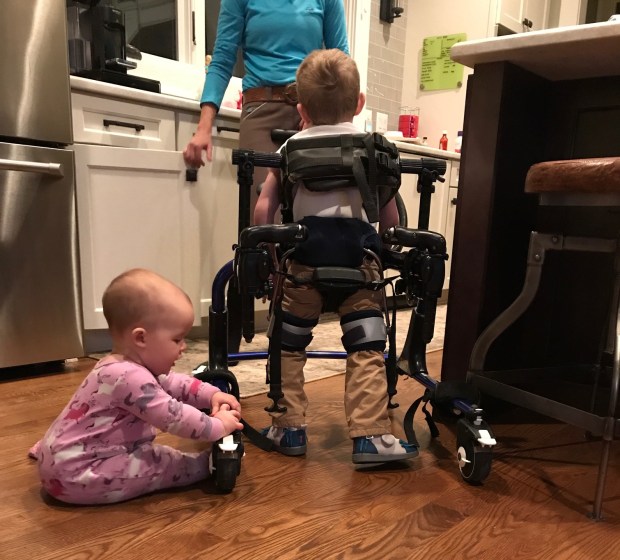
Solly and Bea

Another type of support often seen in our house: sister helping brother!

Word of the Day: Apraxia

Definition: Apraxia is a motor disorder caused by damage to the brain (specifically the posterior parietal cortex), in which the individual has difficulty with the motor planning to perform tasks or movements when asked. (Source)

I remember the first time I heard the word “Apraxia” mentioned as it applies to Solly. It was back in D.C. and Marie, our vision therapist, was holding a teeny tiny baby Solly. She placed him on her left side, trying to get him to move his eyes to look at her. It was difficult. When Solly was born, his eyes were stuck staring to the left side, and for the longest time, I worried this would always be the case. As she continued speaking to him, he started to dart his eyes over to the right side to check her out. It was progress. “It’s almost as if he has visual apraxia,” she said, meaning that he could see, he knew he needed to look to the right to see her, but his ocular muscles weren’t understanding what his brain was telling them to do.

Over the weeks that followed this particular appointment, we continued to work with Solly and his visual control began to improve. Today, if you were to meet Solly, you might see his eyes dance around as he focuses on you, but for the most part, he has good control over his eye movement. We know he sees (his Nana might tell you that he doesn’t miss anything!) and other than some possible peripheral visual field loss, the only thing he struggles with visually is this control over his eye muscles. In my book, since his control has gotten much, much better since those initial days, it’s not that big of a deal. He compensates quite well and it’s just something we’ll continue to watch and find ways to support as he grows up.

While the idea of difficulty with motor planning was often mentioned, especially with our new physical therapist, the term “apraxia” didn’t come up again until we were in Florida for our intensive therapy. While there, the physical therapist working with us watched Solly and suggested we have an evaluation with one of the speech therapists at Lampert’s who has years and years of experience with kids just like Sol.

She was amazing. If I could have packed her up and brought her back to Nashville with us, I would have.

She took tons of notes about Sol’s medical history, watched him eat, and asked him to move his mouth and tongue in certain ways. She explained that he has some apraxia, making it difficult for him to manipulate food in his mouth and move his mouth and hard and soft palettes to make different noises – or, to talk. She gave us a handful of exercises and stretches for Sol’s cheeks, lips, and tongue that will help bring awareness to each part of his mouth to help improve feeding and speaking. After just a couple of days, Sol was eating new textures, comfortably and easily. He’s also gained some weight since we met with her!

Difficulty with motor control affects almost everything Solly does – walk, talk, and grab for and look at objects. But that doesn’t mean that he can’t do them. We just need to teach him how and be patient with him as he figures out how to do what his brain is telling his muscles.

Years ago, I would have freaked out when I heard apraxia as a possible diagnosis. (Yes, it’s still a “possible” diagnosis as it’s not officially on his medical records, yet.) I probably would have jumped in bed, pulled the covers over my head, and cried non-stop. Now, I look at it as a blessing. It helps me understand how he’s processing – and not processing – what we’re teaching him, it tells me what types of people we need on his medical team, and it also reassures me that progress IS possible.

IMG_0518

Peekaboo!