Word of the Day: Apraxia

Definition: Apraxia is a motor disorder caused by damage to the brain (specifically the posterior parietal cortex), in which the individual has difficulty with the motor planning to perform tasks or movements when asked. (Source)

I remember the first time I heard the word “Apraxia” mentioned as it applies to Solly. It was back in D.C. and Marie, our vision therapist, was holding a teeny tiny baby Solly. She placed him on her left side, trying to get him to move his eyes to look at her. It was difficult. When Solly was born, his eyes were stuck staring to the left side, and for the longest time, I worried this would always be the case. As she continued speaking to him, he started to dart his eyes over to the right side to check her out. It was progress. “It’s almost as if he has visual apraxia,” she said, meaning that he could see, he knew he needed to look to the right to see her, but his ocular muscles weren’t understanding what his brain was telling them to do.

Over the weeks that followed this particular appointment, we continued to work with Solly and his visual control began to improve. Today, if you were to meet Solly, you might see his eyes dance around as he focuses on you, but for the most part, he has good control over his eye movement. We know he sees (his Nana might tell you that he doesn’t miss anything!) and other than some possible peripheral visual field loss, the only thing he struggles with visually is this control over his eye muscles. In my book, since his control has gotten much, much better since those initial days, it’s not that big of a deal. He compensates quite well and it’s just something we’ll continue to watch and find ways to support as he grows up.

While the idea of difficulty with motor planning was often mentioned, especially with our new physical therapist, the term “apraxia” didn’t come up again until we were in Florida for our intensive therapy. While there, the physical therapist working with us watched Solly and suggested we have an evaluation with one of the speech therapists at Lampert’s who has years and years of experience with kids just like Sol.

She was amazing. If I could have packed her up and brought her back to Nashville with us, I would have.

She took tons of notes about Sol’s medical history, watched him eat, and asked him to move his mouth and tongue in certain ways. She explained that he has some apraxia, making it difficult for him to manipulate food in his mouth and move his mouth and hard and soft palettes to make different noises – or, to talk. She gave us a handful of exercises and stretches for Sol’s cheeks, lips, and tongue that will help bring awareness to each part of his mouth to help improve feeding and speaking. After just a couple of days, Sol was eating new textures, comfortably and easily. He’s also gained some weight since we met with her!

Difficulty with motor control affects almost everything Solly does – walk, talk, and grab for and look at objects. But that doesn’t mean that he can’t do them. We just need to teach him how and be patient with him as he figures out how to do what his brain is telling his muscles.

Years ago, I would have freaked out when I heard apraxia as a possible diagnosis. (Yes, it’s still a “possible” diagnosis as it’s not officially on his medical records, yet.) I probably would have jumped in bed, pulled the covers over my head, and cried non-stop. Now, I look at it as a blessing. It helps me understand how he’s processing – and not processing – what we’re teaching him, it tells me what types of people we need on his medical team, and it also reassures me that progress IS possible.

IMG_0518

Peekaboo! 

One Giant Leap for Sol-kind

This morning, we packed up a small 3 bedroom condo in beautiful Belleair Beach, Florida, buckled the kids into the car, and headed into our final day of Therasuit Intensive Therapy at Lamperts Therapy Group. For the past three weeks, Solly has been working his tail off three hours a day, five days a week. Therasuit is very similar to the intensive therapy we did back in July, except this round was much longer, much more intense, and very regimented.

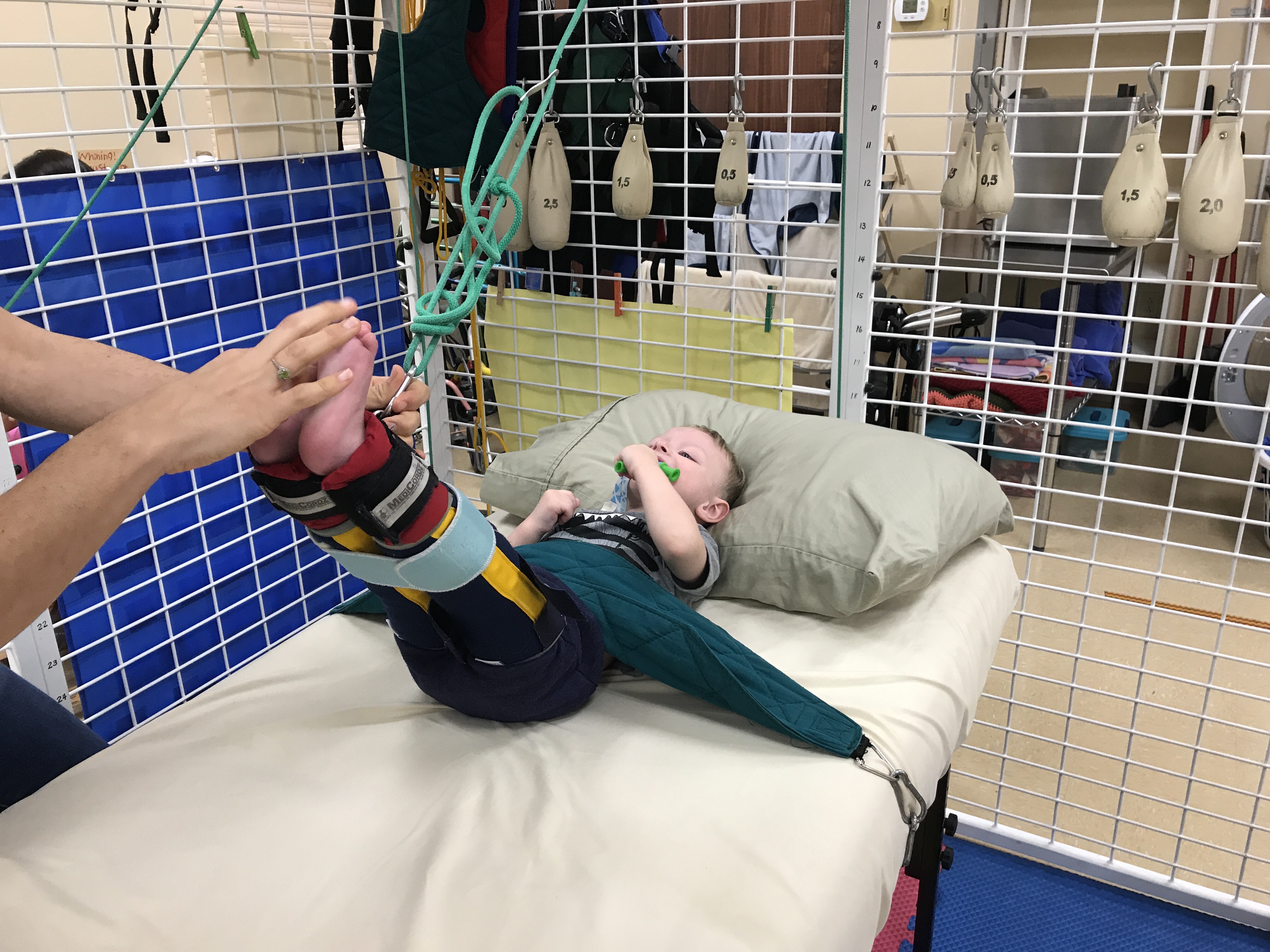
​Every day, therapy began at exactly 9am. For the first hour, Solly started out laying on a table, where Gina, his physical therapist, would apply heating pads to his legs and hips. She’d stretch out each limb, paying super close attention to his legs, hips, and right arm since that’s where he tends to get the tightest. She would then move Solly through a series of table exercises where she’d attach a small weight via a pulley system to his leg or arm and, by lightly tapping him, encourage him to move his limb in a certain way. 

Workin’ those glutes!


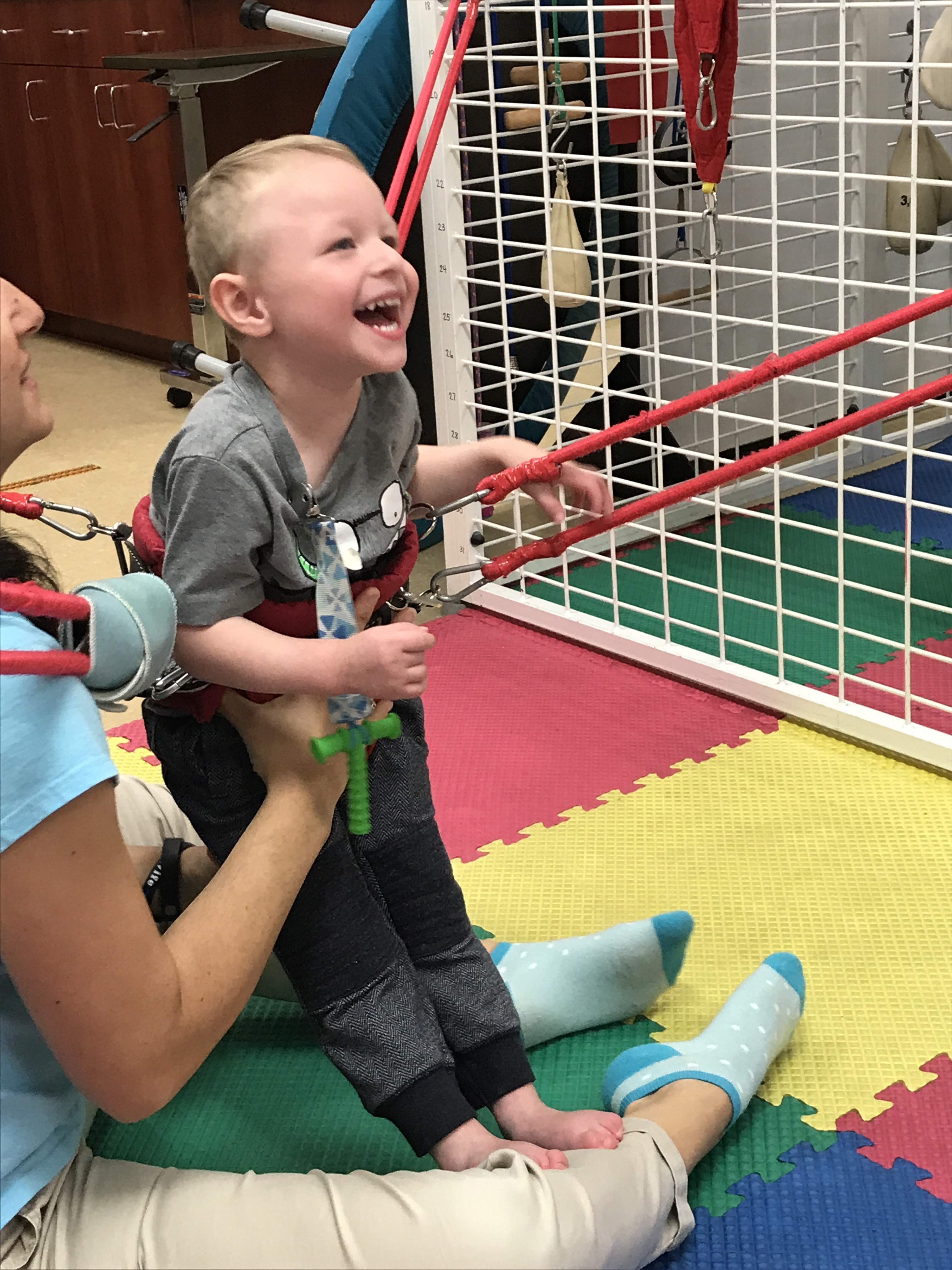
After his stretching and lifting exercises, Solly would either work on walking or on core and arm strength for the remaining two hours. Both of these activities were done with Sol wearing a therasuit, which is a compression garment and a series of rubber strips placed to bring awareness to specific areas of the body. For core and arm strength, she’d move him to the floor to work through sitting, side sitting, tall kneeling, quad position, or sit-to-stands. Walking was done either in a gait trainer or on the treadmill.

Hands and knees – not our favorite


The entire three hour session was tiring for Sol. We made sure to take several breaks for hugs and snacks, but, in true Solly fashion, much of the session was completed with a smile on his face. 

Jumping!


Results from this intensive therapy can continue to be seen for weeks after completion, but here’s what we noticed so far:

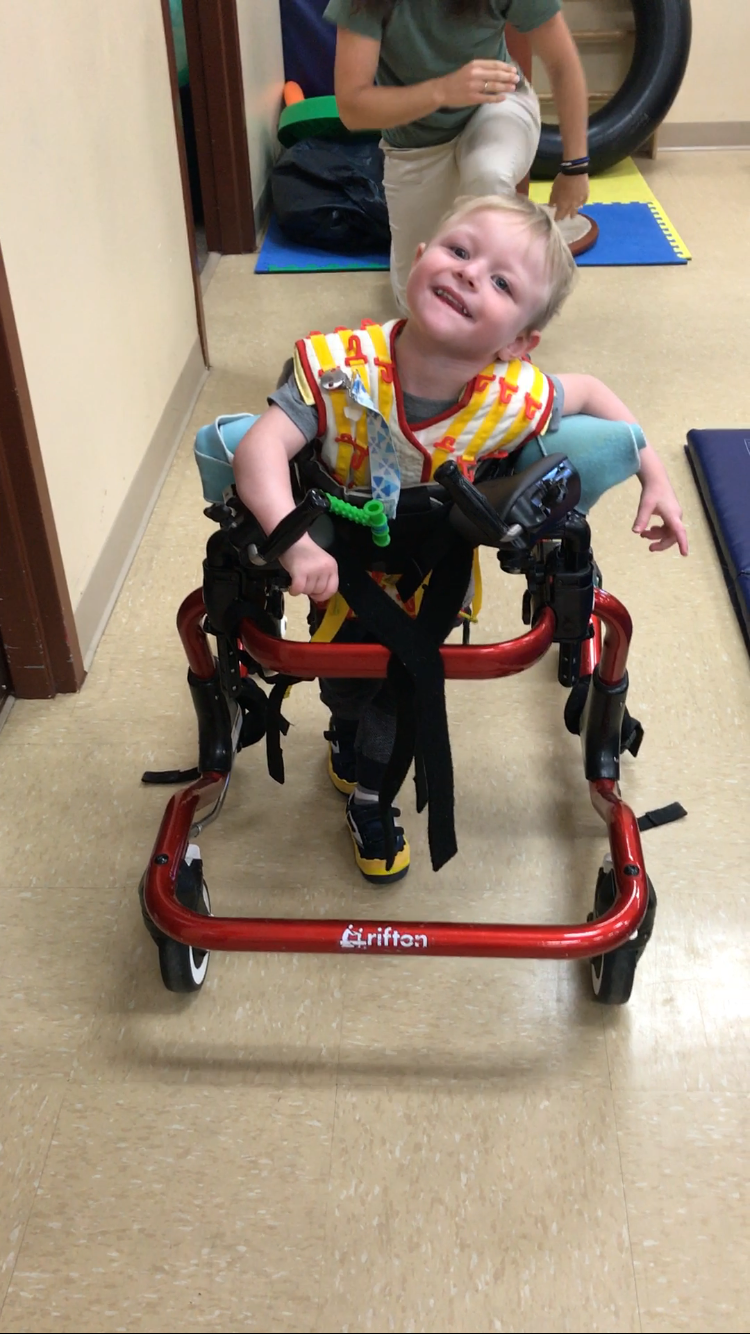
  • Perhaps most excitingly, Solly took his first-ever unassisted steps in a gait trainer!
  • When Sol walks, his legs tend to scissor due to high tone. Part of teaching him how to walk includes proper foot placement to avoid scissoring. Over the final days of the therapy, it seemed that he became much more aware of where his body is in space. We noticed that his foot placement improved drastically, so much so that he could keep his legs from scissoring while walking in the gait trainer.
  • Improved core strength altogether, including arms!

First unassisted steps in a gait trainer


While these gains may seem like itsy bitsy baby steps, being able to walk in a gait trainer on his own is a HUGE gain towards independence. We’re excited to head home, continue the home program that Gina prepared for us, and allow Solly to spend more time in the gait trainer. We hope this will be the first step to him really taking off with walking!

The Secret Life of Special Needs Moms

Y’all, being a Special Needs Mom is unique. It’s hard. It’s exhausting. It’s rewarding in its own way. It’s special. 

To the outside world, it may seem like we – special needs parents – are steadfast, strong, and unbreakable. We speak up for our kids, we never back down, and we have an infinite amount of patience. But, behind closed doors, we feel weak. We question ourselves. Tears flow easily. We always feel guilty. 

Over the past three years, I have befriended so many Mamas and Dads just like us on Facebook, Instagram, and WordPress, and my feeds are peppered with questions and statements like:

My son is doing this strange thing with his arm. Here’s a video – is it a seizure?

My child hasn’t pooped in days. Is this normal?

He’s not drinking again. Do I take him in?

Well, another trip to the ER. Let’s hope we get to go home tonight.

Just found out my daughter has to have double hip surgery. I’m so nervous!

Doctors are saying my infant son’s head isn’t growing. I’m super paranoid about it and am now measuring it every day. Is this normal?

I’m just so tired and no one seems to support me or understand what I’m going through

This is our norm. It’s what we face every day. It’s our secret little world, one that only special needs parents “get”. Despite what many parents of typical children say, no, our journey is not like theirs. 

Time can make the special needs journey easier. Eventually, you find strength in yourself to stand up to a therapist who doesn’t believe in your child. You change doctors who don’t have the same philosophies as you without feeling guilt. You start seeing your child as your child and not as a diagnosis.

One thing that I have struggled with since day one are stares and comments as we venture out into the public. When Solly was eight months old, I remember feeling hurt when someone commented that they thought he was only 3 or 4 months old because of his gross motor delay. I wrote about another time when a cashier mentioned that Solly reminded her of her grandson who had CP and autism and was institutionalized. As Solly gets older and his disability becomes more obvious, the stares and whispers of strangers are increasing. 

This used to keep me holed up at home. Just the thought of the possibility of an off-color remark about my son turned me into a recluse.  But in the past year, things have started to change. Yes, for many reasons, it’s still difficult for us to get out and enjoy things as typical families would – family gatherings, neighborhood barbecues, trips to the park. But we are starting to enjoy adventures like these in our own way. 

A few weekends ago, we headed out to the Cheekwood Estate and Gardens. They’d recently opened up Cheekwood Harvest, which had been on my list of things to do in Nashville. When we got there, we made a beeline for the pumpkin patch. I pulled Solly out of the stroller and plopped him down on his feet, keeping him steady with my hands. I showed him the pumpkin house, and all the pumpkins in the pumpkin patch – big, little, white, green, orange. As I pointed out all the pumpkins, I slid my hands under his arms and whispered “kick, kick, Solly”. He began taking steps with my support and together we walked the length of the pumpkin patch. I’m sure we got loads of looks and stares – Solly sporting his AFO and SWASH braces among the perfectly dressed toddlers of Nashville, all decked out for their Fall photos. But in that moment, I could have cared less. My son was taking assisted steps and checking out the pumpkins with me. For once, my secret special needs world was not-so-secret anymore and I couldn’t be prouder of it.

Walking through the pumpkin patch

Growing Past Panic Mode

Trigger warning: if you can’t stomach conversations about vomit, skip this post and wait for the next one!

A couple of weeks ago, I hit the panic button. It was the middle of the night, I woke up with a start. It took a few seconds to register, but I definitely heard something, someone was coughing.

At first, I thought it was Bea trying to wake me up for her typical nighttime feeding, but I quickly realized it was something more serious than that. Solly was coughing, choking, upstairs in his bedroom. I sprinted upstairs to find him vomiting and choking in his crib. Normally, he’d be able to roll over and clear his airways, but ever since he had SPML surgery, he’d been sleeping in a fairly heavy duty hip support that is difficult to roll in. I sat him up and patted his back until he stopped throwing up and then took him downstairs to get cleaned up.

I thought he seemed somewhat disoriented and was jerkily moving his arms and legs. I jumped to the worst-case conclusion: seizure. To our knowledge, Solly has not had a seizure since he was in the NICU, and even while he was there, I never witnessed him having one. However, from the nurse’s notes, I knew that his seizures presented with jerking movements in his right arm and leg, and I’d also read from other parents that their children often vomited after having a seizure. We’ve kept him on Keppra, an anti-seizure medication, out of precaution since his EEG’s had almost always been abnormal. An EEG just three weeks prior to this evening showed an improvement in his brain activity, so it seemed like we were moving in the right direction to begin thinking about weaning him off of Keppra. However, at this point, it seemed that these hopes had gone down the drain.

We gave Solly his rescue seizure meds and a quick bath and, because it was 1 a.m. at this point and there would be no one at his neurologist’s clinic to give advice, I put Solly in the car and took him to the E.R. in case he had another seizure.

Once I got him to the E.R., I had my regular Solly back. Several doctors examined him and couldn’t find a reason why he would have a breakthrough seizure, other than possibly being fatigued from our recent vacation. Typically after a seizure, children will be very tired and sleep for quite a while. Solly was awake, playing with me in the E.R., and very much the happy-go-lucky little kid that he is day in and day out. It didn’t SEEM like he had a seizure. The doctors felt that we could go home, increase his dose of Keppra as a precaution, and follow up with his neurologist the next day if needed.

In the days following our E.R. visit, I couldn’t quite wrap my head around the event. If it was a seizure, was it just a random event? Did we need to increase his medications and follow up with his neurologist? Solly has some extra sensory needs and often needs to chew on things as a result. I considered another scenario and thought maybe he woke up in the middle of the night and started putting his hands in his mouth, accidentally making himself vomit. But even that explanation didn’t sit well with me.

Six days later, Solly threw up again. Twice. This time, it was in the evening, my parents were with us, and we all witnessed it. Nothing made him throw up. He didn’t have a fever, he wasn’t sick, he didn’t have a seizure and he didn’t have his hands in his mouth. He just threw up.

And then it hit me. In the days leading up to Solly’s nighttime event, he’d been eating more. Like, a lot more. What if these vomiting episodes had to do with motility?

Coincidentally, just days later, we had our first appointment with a new feeding therapist. She confirmed it: when anyone goes through a major growth spurt, sometimes esophageal muscles have trouble keeping up and coordinating. This is especially the case with kiddos that have CP. Some vomiting is common with a growth spurt.

So, there you have it. Our Solly is finally going through a major growth spurt! In the last week, we’ve even had to buy him bigger pants and pajamas. Eating and growing has always been a challenge for us, so I couldn’t be more pleased. I certainly hope this uptick in eating continues! And for that panic mode? I’m sure that’s not the last time I’ll hit the panic button with Solly. But for now, I can rest easier and try sleeping without always keeping one eye on the baby monitor.


img_0225

Our big kid, recently playing at the park.

Two Months Post-SPML

This Sunday will mark two months since we made the difficult decision to have Selective Percutaneous Myofascial Lengthening (SPML) surgery. We’ve been hard at work over the past two months, doing some intensive therapy as well as weekly hippotherapy, and, boy, are we seeing some great gains.

For those of you who know Solly personally, you might remember the “old” Solly as a little boy who could not stand or move his legs reciprocally.

This was Solly in April:

Last night, Mike “walked” Solly around the kitchen for a good 20 minutes so Solly could explore, open drawers and cabinets, and see the world from a new height. It was pretty amazing. I was on cloud nine watching Solly move around in ways I never thought would be possible given the level of tightness he had earlier this year.

This is something that we practice every day. We used to try to get Solly in his KidWalk daily before the surgery, but he grew increasingly frustrated in it because he couldn’t move the way he wanted to. Now, he can not only move in it but he enjoys the time he spends walking around in it.

Pretty cool, right?