Despite what the title might suggest, this post isn’t about anger. It’s about seeing. Actual vision. Seeing red things.
Today, Dr. Newcomb with the University of Maryland’s Connections Beyond Sight and Sound came to our house to evaluate Sol’s functional vision. To be honest, I’ve been so nervous about this appointment and had a hard time sleeping last night. I think after going through an experience in the NICU like we did, I will always worry when new things could possibly pop up with Sol. While I’ve been anticipating and coming to terms with his possible vision impairment, I still felt very uneasy as this appointment approached.
The good news: Solly can see. And he’s eager to see. “Visually curious” is how Dr. Newcomb put it. Sol was napping when Dr. Newcomb arrived, so we sat down and I filled her in on Sol’s background. I let her know that while his eyes have always preferred the left side, more and more we’re seeing them dart around in all directions. He doesn’t focus on anything for very long and he rarely tracks, but sometimes we think he looks at his toys or the dogs, and he is definitely reaching for toys. She said that based on his background (the stroke) and some of his tendencies (not focusing, left-sided gaze), he is a likely candidate for CVI. At this point, since he’s only 3 months old, it’s too early to tell the degree of the CVI. We’ll have a formal evaluation when he’s 6 months old to understand its severity. However, there are some things we can do now to help his seemingly improving vision.
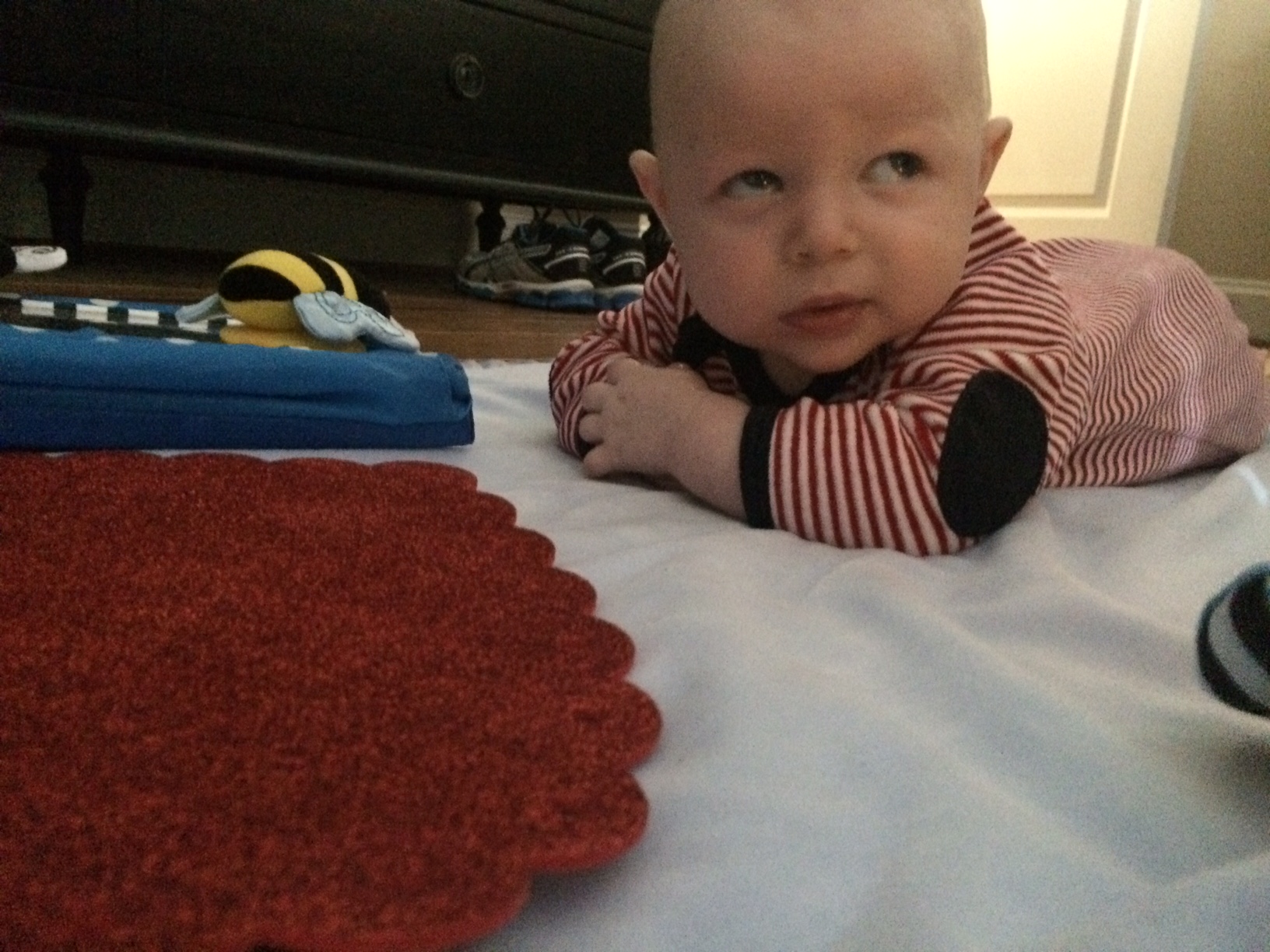
Once Sol woke up from his nap, we took him downstairs where there is less natural light and showed him the toys he typically plays with. Dr. Newcomb simply observed while he reached for his rattles and looked around the room. She then pulled out some “toys” from her bag – items that kiddos with CVI tend to respond to: red tube lighting, pom poms in red and yellow, and mylar paper in, you guessed it, red and yellow. (I mentioned in my last post that CVI kids can see reds and yellows best.) And, boy, did he respond. He gazed at each item and cooed, especially at the lights. She presented the items to his left side, which is where we saw the most engagement. She then presented them to his right side and he tried so hard to move his head and look at them. When I adjusted his head to look to the right, he had a much easier time shifting his eyes to the right to look at each object. It was so encouraging hearing Dr. Newcomb confirm that he was, in fact, able to see and look at each item. Not only that, but there is an actionable plan to help our “visually curious” baby improve his vision over time.
Our homework: We are to incorporate objects that Sol looks at into our daily routines so he has practice seeing throughout the day. Using his vision takes a lot out of him so, unlike physical and occupational therapy, we’ll help improve his vision more if we don’t set aside dedicated time to practice it. We also need to present these objects against a simple background. For kids with CVI, looking at objects against a patterned background makes it look like a “Where’s Waldo” illustration: it’s hard for them to focus on one object at a time. As his vision improves, we’ll be able to incorporate more objects and more patterns.
Next steps: Dr. Newcomb is going to prepare a report of Sol’s evaluation for us to share with our team of therapists so they can incorporate visual techniques into sessions where vision is super important, like tummy time and practicing reaching with his right hand. Then, when he turns 6 months old, we’ll meet with Dr. Newcomb again for a formal CVI evaluation against set criteria, where each criteria is on a scale from 0 (not able to see) to 10 (normal vision). We’ll then work to get each criteria to 10.
I am relieved this appointment went so well. Dr. Newcomb mentioned that early intervention with vision is important and usually has great results, particularly for kids that are eager to learn to use their eyesight (like Sol!). She’s worked with many children who are now in mainstream school and can see and read just like their peers. Based on Sol’s improvements with his vision already, we can only hope and strive for him to have great results.
(If you’re interested in learning more about CVI, I’ve listed some articles and websites on the Resources page and will continue to add to it as we continue our journey.)
This seeing thing is tiring stuff:







 Sol the Man