What A Ham

After Solly was born, we had a month-long stay at the Georgetown University Hospital’s NICU. There, the neonatologist had told us that in order to be discharged, we had to get Sol’s seizures under control and come up with solutions for his oxygen levels and feeding. Seizures were the easiest thing to get under control, followed by removal of all oxygen support. While we were confident that Sol would come home without any feeding support, some of his doctors were less-than-optimistic. I remember expressing some feeding concerns to one of his rounding doctors, a Fellow who was spending some time at Georgetown, and her exact words to me were: “I don’t think he’ll ever eat by mouth. He may be able to have some pleasure feedings by mouth, but he’ll probably go home with a g-tube.”

Less-than-optimistic, right? It was definitely not the kind of thing we wanted to hear.

Luckily, Solly is stubborn (just like his Mama and Dada!) and proved that doctor wrong, leaving the NICU a little over a week later without any feeding support.

However, since leaving the NICU, feeding has continued to be a struggle for us. Sol’s strokes affected his ability to coordinate muscles, including facial muscles, as well as dampened some of his sensory abilities. At three years old, he is still taking the majority of his calories in by bottle and eating some finger foods, but primarily favoring purées that he can eat by spoon or feed to himself with his fingers. We’ve been in weekly feeding therapy since he was one year old to address his muscular challenges as well as a few behavior issues. Progress has been slow, but entirely worth it, especially after we switched to a new, very experienced feeding therapist, Linda, at High Hopes in Franklin, TN.

Continue reading

So long, 2017!

Every once in a while, this roller coaster that we call life heads downwards. Nothing is wrong. It’s just that Solly, Bea and I have been sick with the ick for the better part of a month, which means I have less time to work on Solly’s stretches and exercises, and more time to focus on everything that we aren’t accomplishing.

When life gets like this, I feel a little down for a day or two, and then something as silly as a Facebook memory post knocks me out of my funk. Seeing a post from a year ago reminds me just how much he has grown up and come so far in such a short time. What a year 2017 has been!

We started out 2017 with the mindset that it was the year of change, a year to focus on alternative therapies and procedures as a means to propel Solomon’s progress.

Here’s what we did:

  • First, we added a little sister to the mix. Nope, that wasn’t solely for Solly’s benefit, but let me tell you, having a little sister around has been so good for Solomon. For the first several months of her life, Solly was just so curious about her. He learned how to be gentle around her and to simply observe. Now that she’s a very busy 11-month-old, we’re starting to see the beginnings of a very special sibling bond. Sure, they’re already bickering and picking on one another like siblings typically do, but we’ve also caught them in the act of loving on one another – hugging it out and giggling with each other – and it’s moments like this that make my heart soar. I can’t wait to watch them grow up together!
  • Shortly after Bea’s birth, we moved the family to Hilton Head Island for 2 months so we could start Hyperbaric Oxygen Therapy.
  • In early June, Solly had a procedure called Selective Percutaneous Myofascial Lenthening (SPML). In short, this helped loosen up his legs and give them more range of motion.
  • We followed up SPML by adding hippotherapy to our weekly therapy regimen and we also did two rounds of intensive therapy – one in Nashville and the other in Tampa.
  • And even though we had quite the crazy schedule in 2017, we even found time to cancel all appointments for 10 days and take a vacation.

The end result from our year of change? Progress. Lots and lots of progress. Solly went from having no words to making LOTS of noise (he has about 20 words right now) and from not being able to take any steps AT ALL to taking several assisted steps.

He’s sitting up straighter and by himself for longer periods of time, he’s eating so much better and he’s now insisting on holding his bottle and using his own spoon with assistance. He’s made gains in so many areas!

I’d love to say that 2018 will be a low key year compared to 2017, but that simply won’t be the case. Our year of change showed us many things, but most importantly, it showed us the value in alternative and intensive therapies and the fact that we shouldn’t settle when doctors don’t believe in Solly’s capabilities. This means that in 2018, we’ll be traveling for more intensive therapies and to consult with different doctors and specialists. We’ll also be doing another round of HBOT (in Nashville this time, starting next week!), trying stem cell therapy, and adding an additional weekly hippotherapy session.

I think it’ll be a busy/fun/productive/unexpected year and we’re up for whatever the year throws our way. Stay tuned for updates!

The Right Kind of Support

Before I had Solly in my life, social media was a place to simply share photos, articles, humblebrag, and occasionally whine. Back then, even though I was working in digital marketing, I felt myself growing increasingly annoyed with all the oversharing on all platforms and was particularly ready to pull the plug on Facebook (hello, addiction!).

Then, I had a special needs child. Because of HIPPA, our doctors and therapists couldn’t connect me with other parents going through a similar journey. I connected with a few parents while in waiting rooms, but their child’s diagnosis wasn’t always the same, so I still had questions and craved advice from parents who had been there, done that. So, I started googling and realized how many special needs parents were making those kinds of connections on social media – mostly, Facebook, but also Instagram and Twitter. Over the past three years, I’ve started one support group and have followed and participated in several others. These groups not only help me discover new therapies, new medical treatments, and doctors that can help Solly, but they also give me a place to vent and share wins with people who go through similar ups and downs every day. Plus, I’ve even gotten to meet several local parents who I’ve since met up with in person! (These meet ups are refreshing – it’s always like reconnecting with a long-lost friend.)

A daily walk in the shoes of a special needs parent is certainly not an easy one. But I’ve found that with the right support group, life has gotten a little less scary and, in most cases, I’ve even felt empowered when making decisions for Solly.

If you’re new to a cerebral palsy or stroke diagnosis, or you’re simply looking for help with some of the alternative therapies, here’s a list of my go-to support groups on Facebook:

General

KISS Pediatric Stroke Support (I started this support group with two other stroke Mamas so we could not only connect parents with one another and share experiences, but so we could also follow what non-profits were doing to advance pediatric stroke awareness. We’ve grown to over 1,000 members and have parents from all over the world.)
Mom’s of Pediatric Stroke Survivors (If you’re local to the middle Tennessee area, be sure to join this one. It’s based in Nashville and gives lots of good resources on local therapies and doctors, plus the Mama who started it puts together a meet up every few months.)
CP Warriors, Mommies, Daddies, Grandparents, and Caregivers
2014 Cerebral Palsy Babies Support

Medical & Alternative Procedures

SPML – Selective Percutaneous Myofascial Lengthening
HBOT for Pediatric Neurological Conditions
Parents for HBOT
Stem Cell Therapy for Cerebral Palsy and Brain Injury (Parents Information)
Pediatric Cannabis for CP & Other NeuroMuscular Disorders
Pediatric Cannabis Therapy
Anat Baniel Method Parents/Caregivers

Know of any others I should add to the list? Feel free to send them my way!

As I mentioned above, I’ve also met some parents and gotten great info on other social media platforms. I’ll do my best to put together a post with my favorites, so if Facebook isn’t your thing, stay tuned!

Solly and Bea

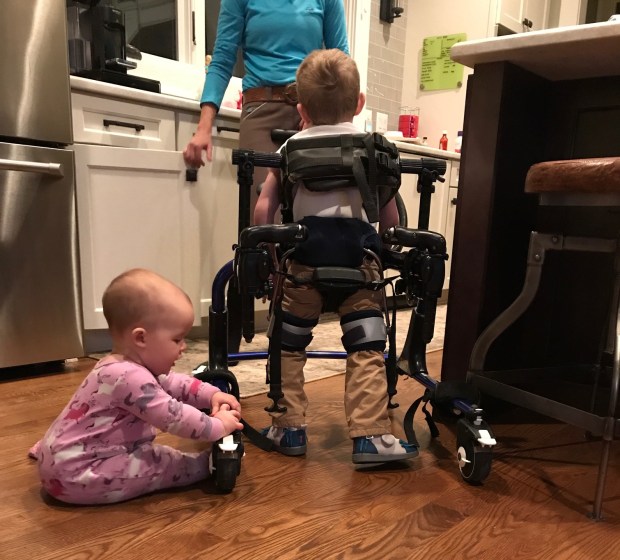
Another type of support often seen in our house: sister helping brother!

Word of the Day: Apraxia

Definition: Apraxia is a motor disorder caused by damage to the brain (specifically the posterior parietal cortex), in which the individual has difficulty with the motor planning to perform tasks or movements when asked. (Source)

I remember the first time I heard the word “Apraxia” mentioned as it applies to Solly. It was back in D.C. and Marie, our vision therapist, was holding a teeny tiny baby Solly. She placed him on her left side, trying to get him to move his eyes to look at her. It was difficult. When Solly was born, his eyes were stuck staring to the left side, and for the longest time, I worried this would always be the case. As she continued speaking to him, he started to dart his eyes over to the right side to check her out. It was progress. “It’s almost as if he has visual apraxia,” she said, meaning that he could see, he knew he needed to look to the right to see her, but his ocular muscles weren’t understanding what his brain was telling them to do.

Over the weeks that followed this particular appointment, we continued to work with Solly and his visual control began to improve. Today, if you were to meet Solly, you might see his eyes dance around as he focuses on you, but for the most part, he has good control over his eye movement. We know he sees (his Nana might tell you that he doesn’t miss anything!) and other than some possible peripheral visual field loss, the only thing he struggles with visually is this control over his eye muscles. In my book, since his control has gotten much, much better since those initial days, it’s not that big of a deal. He compensates quite well and it’s just something we’ll continue to watch and find ways to support as he grows up.

While the idea of difficulty with motor planning was often mentioned, especially with our new physical therapist, the term “apraxia” didn’t come up again until we were in Florida for our intensive therapy. While there, the physical therapist working with us watched Solly and suggested we have an evaluation with one of the speech therapists at Lampert’s who has years and years of experience with kids just like Sol.

She was amazing. If I could have packed her up and brought her back to Nashville with us, I would have.

She took tons of notes about Sol’s medical history, watched him eat, and asked him to move his mouth and tongue in certain ways. She explained that he has some apraxia, making it difficult for him to manipulate food in his mouth and move his mouth and hard and soft palettes to make different noises – or, to talk. She gave us a handful of exercises and stretches for Sol’s cheeks, lips, and tongue that will help bring awareness to each part of his mouth to help improve feeding and speaking. After just a couple of days, Sol was eating new textures, comfortably and easily. He’s also gained some weight since we met with her!

Difficulty with motor control affects almost everything Solly does – walk, talk, and grab for and look at objects. But that doesn’t mean that he can’t do them. We just need to teach him how and be patient with him as he figures out how to do what his brain is telling his muscles.

Years ago, I would have freaked out when I heard apraxia as a possible diagnosis. (Yes, it’s still a “possible” diagnosis as it’s not officially on his medical records, yet.) I probably would have jumped in bed, pulled the covers over my head, and cried non-stop. Now, I look at it as a blessing. It helps me understand how he’s processing – and not processing – what we’re teaching him, it tells me what types of people we need on his medical team, and it also reassures me that progress IS possible.

IMG_0518

Peekaboo! 

One Giant Leap for Sol-kind

This morning, we packed up a small 3 bedroom condo in beautiful Belleair Beach, Florida, buckled the kids into the car, and headed into our final day of Therasuit Intensive Therapy at Lamperts Therapy Group. For the past three weeks, Solly has been working his tail off three hours a day, five days a week. Therasuit is very similar to the intensive therapy we did back in July, except this round was much longer, much more intense, and very regimented.

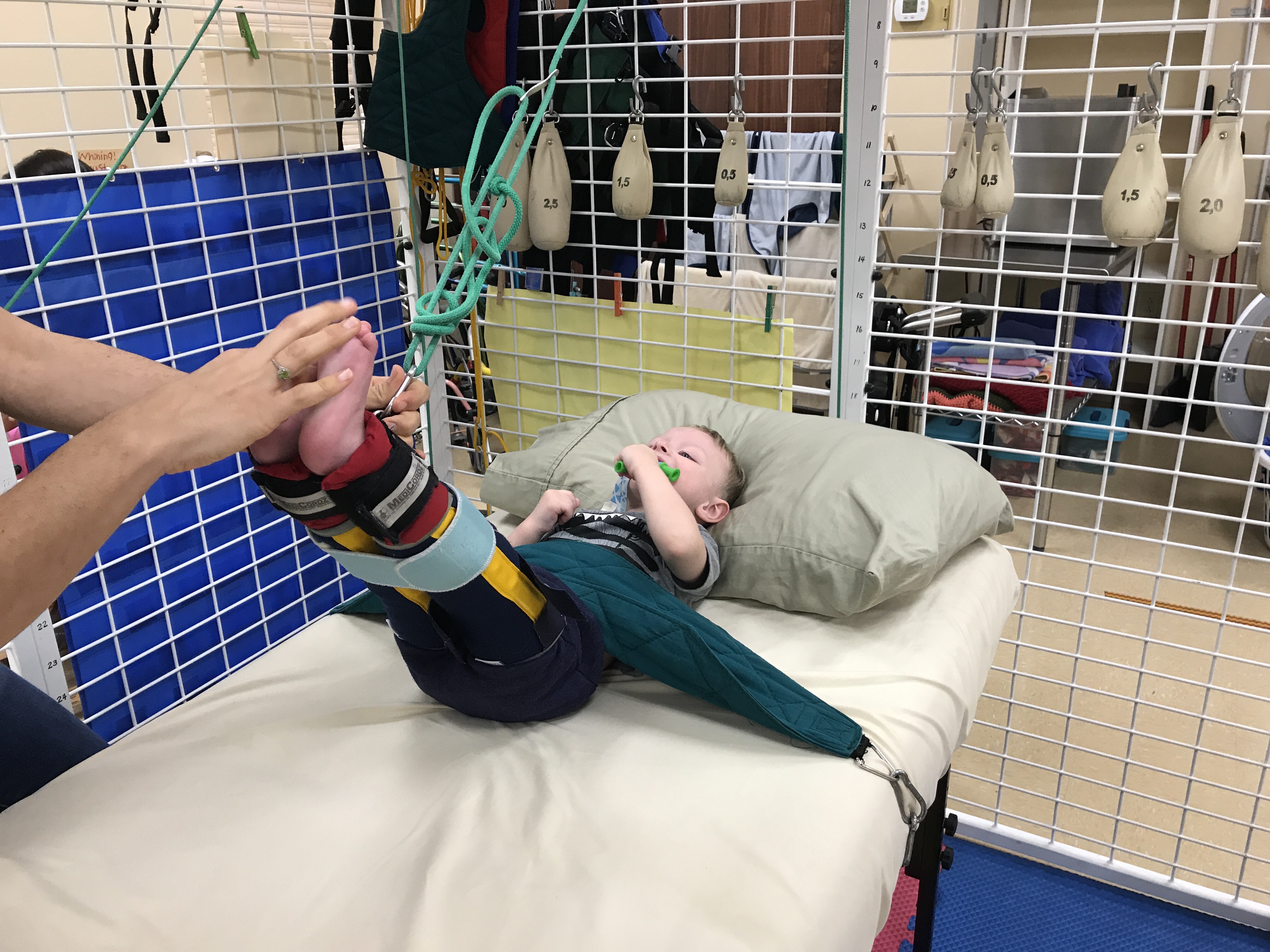
​Every day, therapy began at exactly 9am. For the first hour, Solly started out laying on a table, where Gina, his physical therapist, would apply heating pads to his legs and hips. She’d stretch out each limb, paying super close attention to his legs, hips, and right arm since that’s where he tends to get the tightest. She would then move Solly through a series of table exercises where she’d attach a small weight via a pulley system to his leg or arm and, by lightly tapping him, encourage him to move his limb in a certain way. 

Workin’ those glutes!


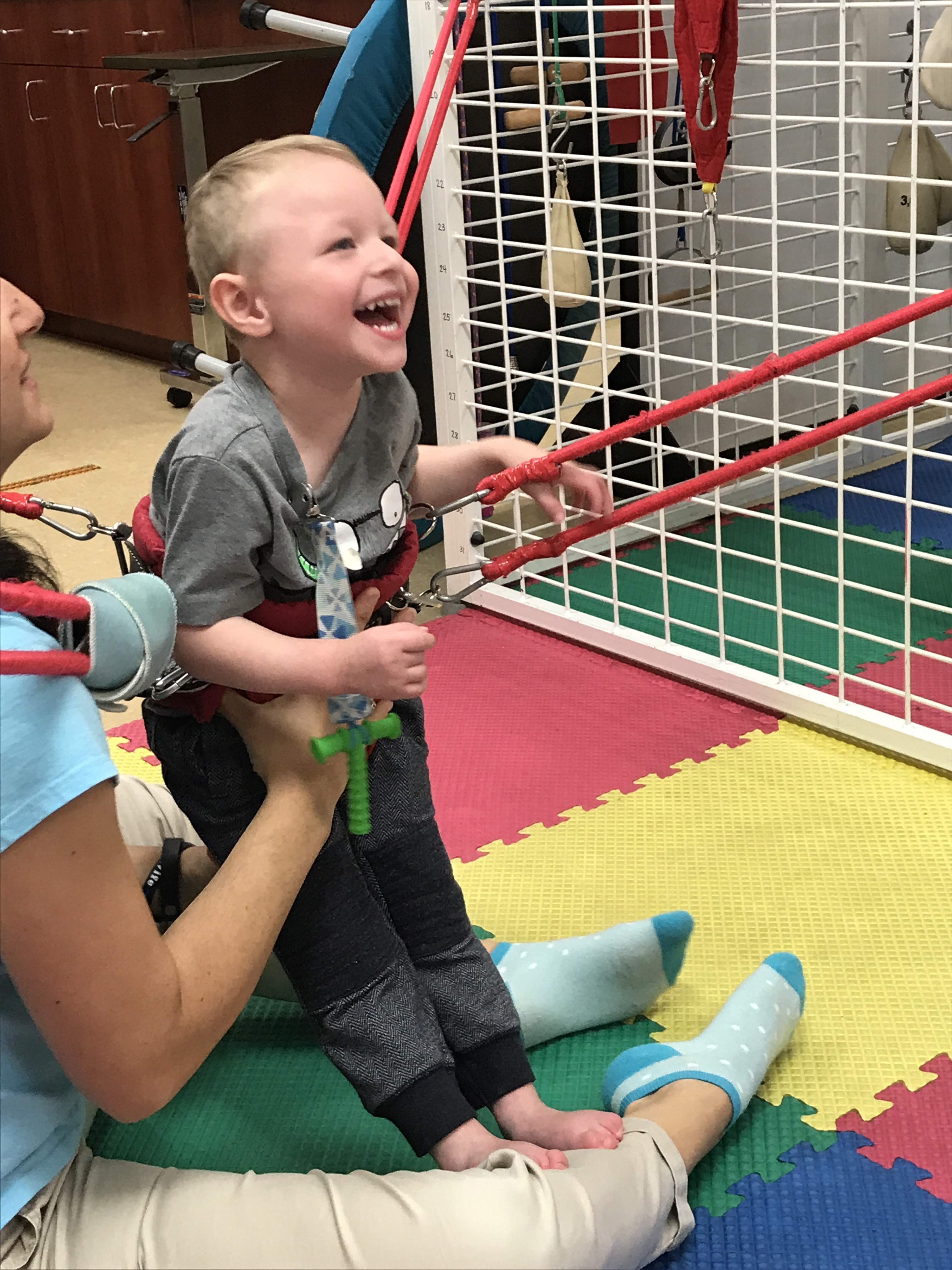
After his stretching and lifting exercises, Solly would either work on walking or on core and arm strength for the remaining two hours. Both of these activities were done with Sol wearing a therasuit, which is a compression garment and a series of rubber strips placed to bring awareness to specific areas of the body. For core and arm strength, she’d move him to the floor to work through sitting, side sitting, tall kneeling, quad position, or sit-to-stands. Walking was done either in a gait trainer or on the treadmill.

Hands and knees – not our favorite


The entire three hour session was tiring for Sol. We made sure to take several breaks for hugs and snacks, but, in true Solly fashion, much of the session was completed with a smile on his face. 

Jumping!


Results from this intensive therapy can continue to be seen for weeks after completion, but here’s what we noticed so far:

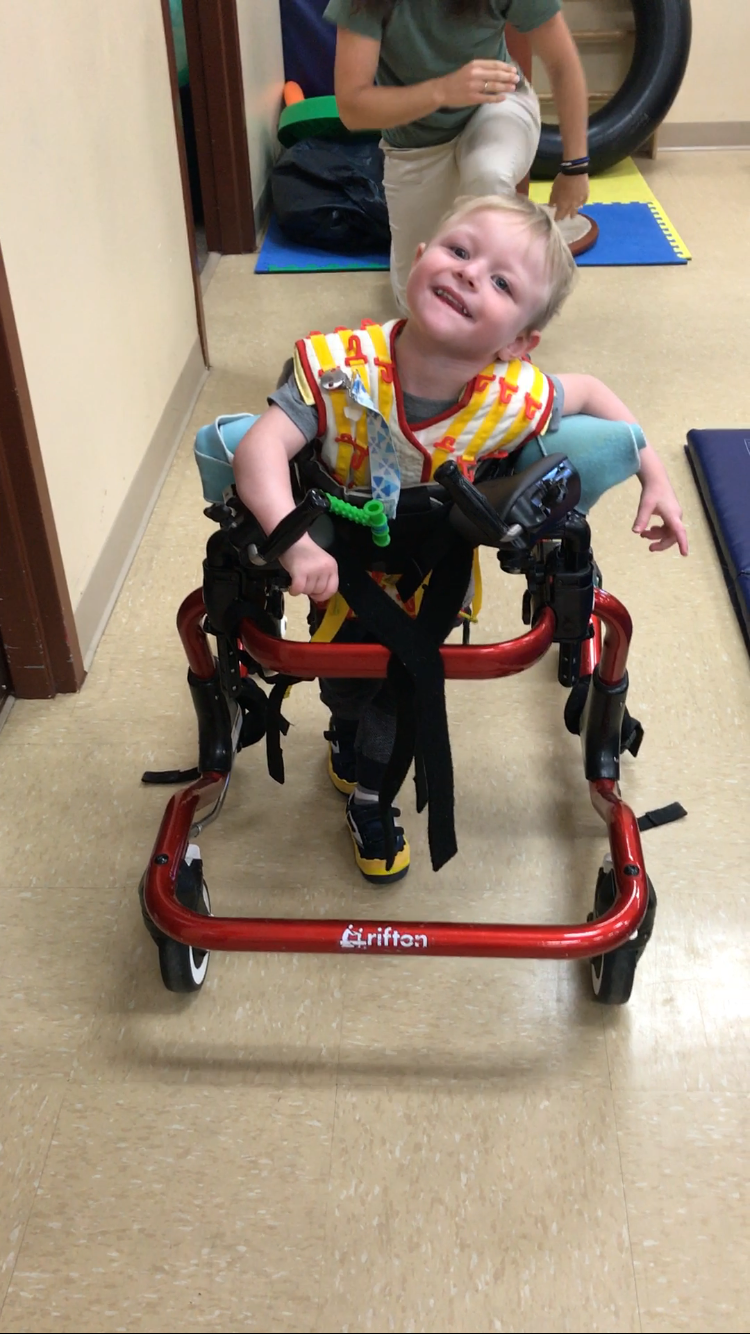
  • Perhaps most excitingly, Solly took his first-ever unassisted steps in a gait trainer!
  • When Sol walks, his legs tend to scissor due to high tone. Part of teaching him how to walk includes proper foot placement to avoid scissoring. Over the final days of the therapy, it seemed that he became much more aware of where his body is in space. We noticed that his foot placement improved drastically, so much so that he could keep his legs from scissoring while walking in the gait trainer.
  • Improved core strength altogether, including arms!

First unassisted steps in a gait trainer


While these gains may seem like itsy bitsy baby steps, being able to walk in a gait trainer on his own is a HUGE gain towards independence. We’re excited to head home, continue the home program that Gina prepared for us, and allow Solly to spend more time in the gait trainer. We hope this will be the first step to him really taking off with walking!