Solly’s schedule is filled with endless therapies and doctors appointments, sometimes up to 4 appointments a day. Last week, I think we hit an all-time appointment record with 15 appointments in one week! While we’ve adjusted his therapies to try and have as many “fun” therapies as possible and Solly generally comes out of each appointment with a big ol’ smile on his face, I still sometimes worry that he’s missing out on typical toddler fun activities. I find myself wondering, how can I get my special needs kiddo involved in something that other kids his age or of his ability might be interested in that isn’t therapy?
Whatcha Say
“May I ask what he has?”
I blinked my eyes several times. Did I just hear the Starbucks barista right? Did she just ask me what condition my son has?
“Excuse me?” I said, with a smile.
“What does he have?”
“Oh, Solly? What does he have? You mean …….. He has CP,” I said quietly, nervously. I was hoping that’s what she meant by her question, not wanting to make her feel awkward if it wasn’t.
“Oh, CP! My oldest has Asperger’s. I’m a special needs Mom, too,” she replied. “Bye, bye, Solly. Come back, soon!”
This conversation was such a breath of fresh air that I literally skipped back to the car with my chai tea latte in one hand and Solly in my other arm.
When you have a special needs child, every outing has its share of stares. It used to bother the heck out of me and keep me inside the house. Now, I’m so used to it that I don’t notice, I don’t have time to dwell on it and, quite frankly, I don’t care if a handful of strangers stare at my obviously delayed and different child. However, one of the hardest parts of being a special needs Mom is feeling different and outcast from the general public, and the stares certainly don’t help. The problem, I’ve realized, is that unless you are a special needs family, you simply don’t know what to do or say when you see a child or person who’s a little bit different. And, instead of saying something to that family or child, you might wonder “what’s wrong with that child” and worry about what to say and decide it’s best to say nothing at all.
Shake Your Hips
Ever since we flew home from New Jersey where Solly had the minimally invasive SPML surgery last June, I have been worrying non-stop about the health of his hips. Hip issues are common in children with cerebral palsy: tight, spastic leg muscles compounded with less time spent weight-bearing not only cause the hips to pull out of the socket, but also make it difficult for the hip sockets to form completely.

Sister, Solly, and the big ol’ brace
After SPML, we were sent home with the instructions to keep Solly in a brace as much as possible to keep his legs from scissoring and then do another set of X-rays after six months to see if the surgery was a success. For the first six weeks, we had him in a custom hip abduction brace 24/7. Once he had recovered from the surgery, we changed up our routine so he would sleep in his custom brace and wear a SWASH brace during the day or be brace-less under a watchful eye. Even though we were sticking to the plan and our physical therapist assured me we were doing everything possible, I still worried that his left hip would begin to dislocate again, resulting in a very invasive surgery to stabilize both hips.
Just Passin’ Time
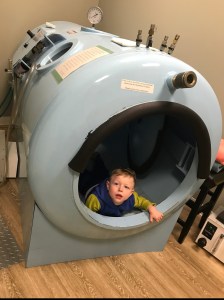
Solly in his submarine
This morning, Solly and I finished our 5th of 40 dives in our second round of hyperbaric oxygen therapy (HBOT).
As I’ve told folks about this therapy over the past few days, the biggest question I’ve gotten is: how the heck do you pass the time in that chamber? During our first round of treatment, the answer to this question was easy: we were in a sleek, all-glass chamber with a TV on the outside, so we’d watch an hour of Sesame Street or Fixer Upper and our time in the chamber would pass by rather quickly. However, the local facility where we’re doing our second round of HBOT has a very different chamber called the Fortius 420, which looks a bit like a submarine – it’s fairly dark, has three small windows, and no TV (eek!). This difference is, in part, what led to my anxiety before we began our second round of treatment. I kept worrying, “How was I going to entertain a 3-year-old in an enclosed space for over an hour every day….. and stay sane?”
In sum, we spend 75 minutes in the chamber. We “descend” to a pressure of 1.5 atmospheres for about 7 minutes, we are at that depth for 60 minutes, and then we “ascend” for about 7 minutes. We’re allowed to bring a bottle for Solly to drink, a few books, and some approved toys.
HBOT FAQs
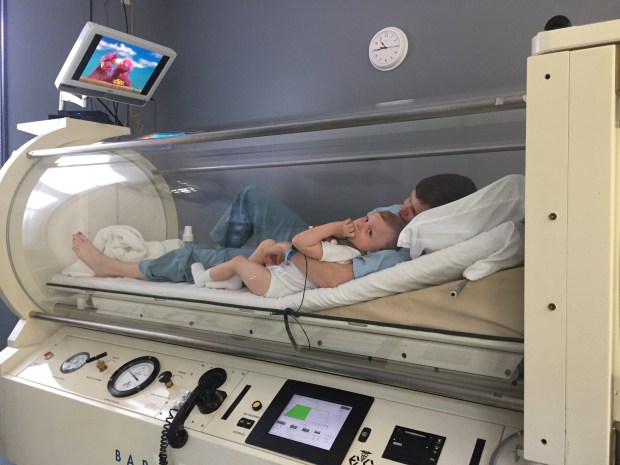
Our first-ever HBOT dive
Every time before we start a new therapy or see a new doctor, I have trouble sleeping. I sit up, worrying about what could happen or what could go wrong. The fear of the unknown always comes out to play. This was very much the case last night. Today, we are starting our second round of hyperbaric oxygen therapy (HBOT). I know, we already did one round – 40 dives – of this treatment last Spring (see related posts here), I should be a pro at this, right? The answer should be yes, however this go around, we are trying a different chamber at a local family clinic. So, new procedures, new doctors, new place, new chamber…..it was nerve-wracking in the hours leading up to our appointment, but we’ve now gotten the first dive of our second round of 40 dives under our belt.
When parents learn about the potential healing benefits of hyperbaric oxygen therapy (HBOT), there are so many questions and uncertainties that arise before starting this treatment. Because it is an alternative treatment, there isn’t a ton of (U.S.-based) research to support it, and most doctors will try and dissuade patients from doing it.
Given this general lack of support and information for HBOT, I thought I’d post some of the questions I’m often asked most by other parents. It’s my hope that these will help provide answers for other parents researching HBOT as a possible therapy for their own child:
 Sol the Man