Mama Guilt, Be Gone!

Mama-and-Solly

Flashback to one year ago

All Moms struggle with guilt. Whether its choosing to go back to work a few weeks after her baby is born or wondering if she’s feeding her kids the right foods or any number of other situations, it’s a common feeling among all mothers. In my particular situation, I spent the first 10 months of Sol’s life feeling guilty that something I did (or didn’t do) caused Sol’s stroke. Again, this is a common source of guilt among Moms of stroke babies, and in 99% of the cases, the stroke was the result of a random mutation or a clot that no one saw coming. But, I always wondered if maybe I stopped running a little earlier or if I had passed up that occasional Starbucks Chai Latte, Sol’s situation would have been different.

Thankfully, right before we left DC, my feelings of guilt were put to rest.

After 10 months of choosing not to look at Sol’s MRI out of pure fear for what it looked like, I decided I would feel better knowing what it looked like. I asked Dr. Newport, the director of Georgetown University’s Center for Neuroplasticity, a woman who I greatly admire and trust, to view his MRIs and walk me through them.

Those 10 months of not knowing what those images looked like may have worked in my favor: based on what the NICU doctors had told us, I imagined the absolute worst – a sliver of healthy brain tissue and not much else. Not so much. I assure you, his MRI is still scary to look at. I learned that he had at least three strokes, one in the left MCA (ischemic) and one in left and right ACA (hemorrhagic), and these strokes were massive, completely destroying brain cells in these areas. The MRI also showed a spot in the right MCA, which could have been a fourth stroke or the result of blood in his brain after the brain injury.

Sounds like a lot, right? It is… BUT what’s promising is that, through the areas of research that Dr. Newport and her team are commanding, doctors are finding that if one area of an infant’s brain is injured, other areas on the other side of the brain can take over. For example, since the left MCA was impacted (this houses the speech centers, for example), the right MCA can take over those duties. Because both the right and left ACAs, the areas that control executive functioning (think attention and organization skills) were affected, we are unsure how his brain will rewire to compensate for these areas. In fact, we’re unsure how his brain will rewire altogether. Because the left side of his brain bore the brunt of the damage, we DO know that his right side will always be weaker. Other than that, how well he continues to recover is left up to God, good luck, therapy, and Sol’s will and determination. He could very well be wheelchair-bound or never gain use of his right hand, but watching him work hard on standing in therapy and seeing him concentrate to bring his right hand to a toy tells me that he will make strides in all areas.

And, going back to that talk of guilt, Dr. Newport said that, based on his MRIs, it was obvious that nothing I did during pregnancy and nothing that the doctors did during delivery caused Sol’s stroke. It was most definitely a clot or multiple clots that broke off from the placenta during delivery – nothing more, nothing less.

While this news doesn’t make Solly’s situation any better, it does put my mind at ease and allows me to focus more on creating the best environment for his recovery – and that WILL help him improve.

It Takes a ‘Ville

Working on sitting

Working on sitting

It’s been one heckuva month! After feeling like we’d been in plateau-mode for so long with Sol’s milestones, this month, Sol kicked it into high gear and ticked a couple more items off his list.

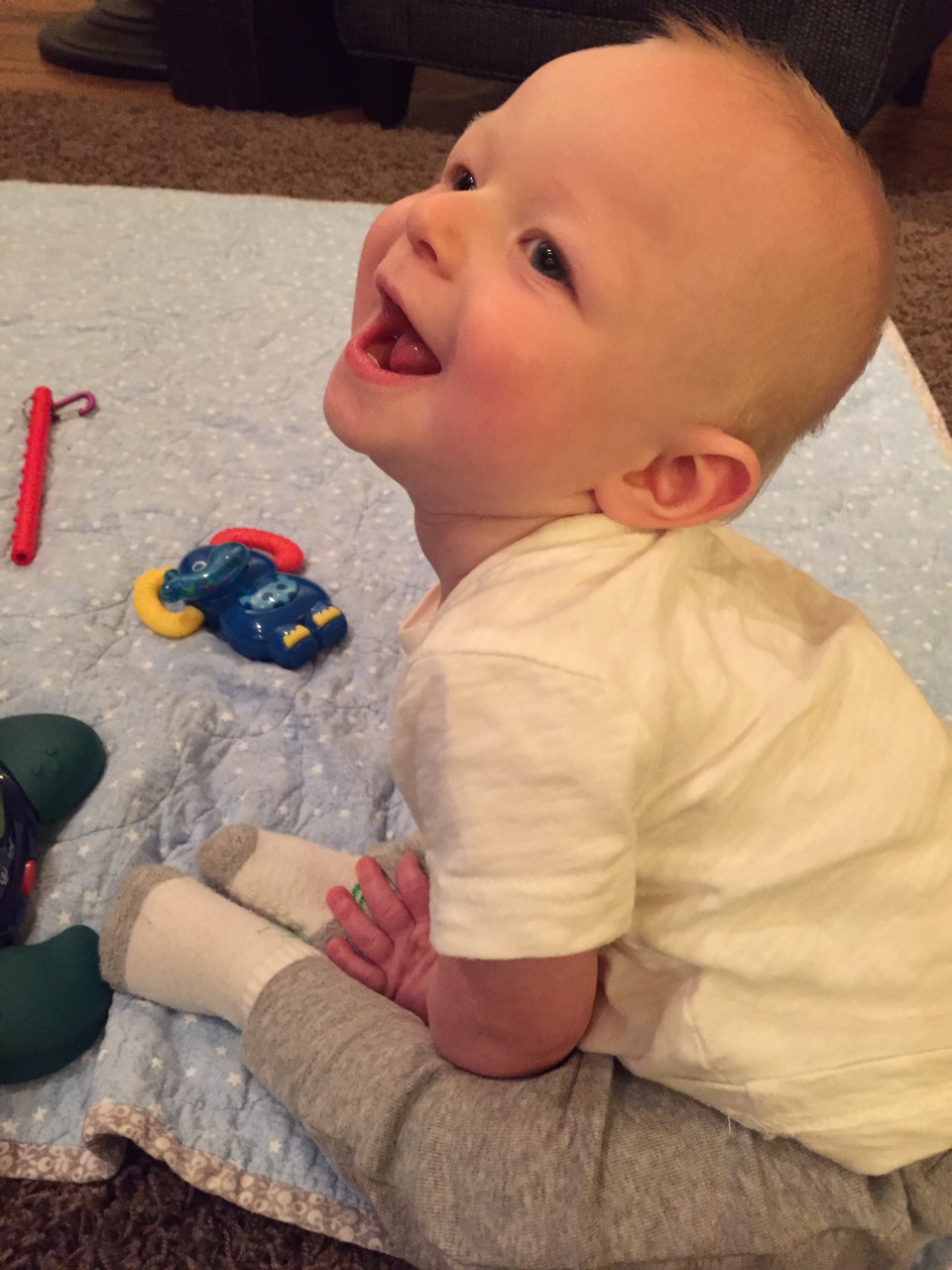
In the gross motor skill department, he started rolling over his right shoulder. Previously, he’d only been able to roll to the left. This is amazing news since his right side is so much weaker than the left: this means all of our work in PT is paying off and his right side and shoulder muscles are getting much stronger. This also means danger: Sol is no longer immobile! If I put him down for 2 seconds, he rolls to the other side of the room! Speaking of mobility, Sol is also starting to pull himself forward on his belly. We get one or two scoots in a row, primarily to get to toys. This kid wants to move! He’s also getting so much stronger with sitting and can sit for longer periods of time. Our next goal with sitting is to sit taller and teach Sol to catch himself with his hands if he begins to tumble over. Since he is scooting forward using his arms, we are now working in PT to get his legs moving, primarily by teaching him how to pull up from kneeling to standing.

Eating avocado

Eating avocado

Sol has global delays, but one area in particular that began to worry me was language. He started cooing around 3 – 4 months, but months 6, 7, 8, 9, and 10 came and went with absolutely no babbling. Last week, I was talking to our OT about Sol’s eating and told her that I was reluctant to start him on table foods given his tricky history with feeding. Our experience with therapists and nurses repeated itself as she, one, reminded me that he actually didn’t have feeding issues, that any issues with “feeding” were actually related to reflux and constipation. Two, she figured that he was actually putting his hands and other things in his mouth not only because he was teething (we’re up to 6 teeth now!), but also because he was naturally craving something to chew. So she sat Sol down, cut up some watermelon she’d brought for lunch, and gave it to him. It was a hit! Sol is now having blueberries, raspberries, avocado and other small bites with every meal. And the most amazing thing is – with this new venture in feeding, he has also started babbling! He is now saying bwahbwahbwahbhwah and mamamama quite frequently and is constantly jibber jabbing. I’ve said it before, and I’m sure I’ll say it again, these therapists are AMAZING.

Our appointments this past month were generally the usual, with the exception of a hearing test (we passed!) and an aerodigestive clinic. The latter was a 4 hour appointment that focused on Sol’s feeding and is probably better addressed in a separate post altogether. (Let’s just say it was a very long day!) I also sat down with the director of Georgetown’s Center for Brain Plasticity and Recovery to walk through Sol’s MRI for the first time. I learned so much and while Sol’s MRI is a bit terrifying to see, the director reassured me that it she’s seen kids with similar MRIs go on to walk, talk, attend college, and live relatively normal lives. I will also likely walk through this meeting in a separate post, so stay tuned!

Hanging out in the park during an Open House

Hanging out in the park during an Open House

Finally, and most exciting of all, is a huge decision we made this month. As we found over the last year, there’s a lot of value in the old saying “It takes a village to raise a child.” As organized as you can be, it just isn’t possible to be superMom or superDad all the time – you need help! We’ve had incredibly supportive friends in DC who would be there in a heartbeat if we needed them, but it’s hard to ask for help, even when it’s offered often. So, it’s off to family we go – we are moving to Nashville, Tennessee in just two weeks where we’ll live 5 minutes from my sister, 10 minutes from my parents, and 10 minutes from Vanderbilt’s Pediatric Stroke clinic. This move is bittersweet – we’ve loved starting our careers and family in DC and will miss our friends immensely. However, we are very much looking forward to going “home” where we can really focus on keeping ourselves happy and healthy and, most importantly, continue to help Sol recover and get stronger (and not to mention, let his Nana, Papa, Aunt, Uncle, and cousins spoil him rotten!).

The Way, Way Back

I had another rough day on Thursday. After our OT suggested we start doing play dates with other babies, I started worrying about seeing “typically” developing babies and then comparing Sol to them. I know, I should never compare my baby to another, but it is so hard not to. Especially when we know that he’s going to be delayed in some areas.

After I spent a few minutes tearing up and feeling rather down, Mike sat down next to me and pulled up videos of Sol from his first month home from the NICU. He was so teeny then! In the videos, he was barely able to hold his head up in tummy time and was certainly nowhere near being able to move it in a controlled way. He couldn’t put any weight in his arms, and his eyes didn’t budge from the left side. Now, just a few months later, he’s put on a number of pounds (we’re up to 14 pounds now!), can hang out in tummy time all day long, and is starting to push up in his arms (including a little on his right, weaker arm). He’s even sitting up in a supported position and he is trying his darnedest to look all over the place. That smart hubby of mine was simply showing me that no matter what any other baby Solly’s age can do, Sol has made huge strides in his recovery and will continue to do so on his own schedule.

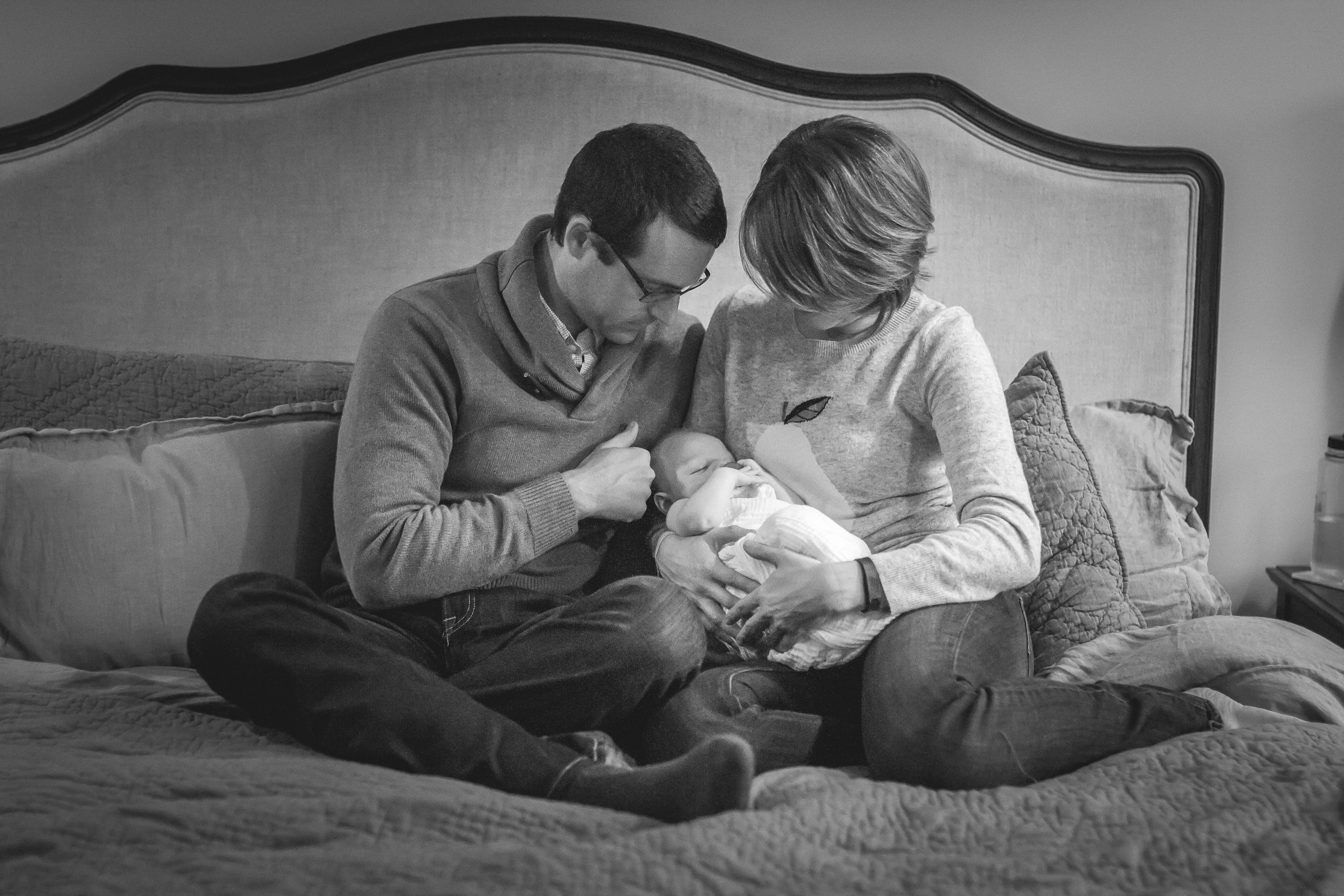
To celebrate how far we’ve come, I thought I’d share a few of my favorite photos of Sol’s “newborn” photo session, which were taken about a month after Sol came home. (All photos were taken by Red Turtle Photography, a fabulous family photographer located here in DC.) I’ll provide a more in depth update this week when Sol turns 5 months old!

December 2014-23 December 2014-39 December 2014-21 December 2014-18 December 2014-12 December 2014-4

Cortical Vision Impairment

After having a rough couple of weeks, over the weekend, I hunkered down and read a book on Cortical Vision Impairment (CVI), which is something that could be affecting Sol’s vision. The book is called Little Bear Sees, and is written by the parents and grandparent of a little boy who is learning to live with CVI.

As opposed to many of the articles that I’d read online, this account of CVI was mostly positive, filling me with hope and ideas for a plan of action (a little b-school nerdiness) should Sol be diagnosed with CVI.

Here are a few points that stood out to me:

  • CVI has absolutely nothing to do with the eyes, so glasses nor surgery will not help it.
  • Because CVI refers to how the brain processes images taken by the eyes, the brain can be rewired or trained to better understand those images. (heck, yeah, neuroplasticity!)
  • Kiddos with CVI tend to see specific, highly saturated colors best (reds and yellows are common), can see familiar items better, and see in a simple environment best.
  • Rather than designating specific blocks of time for vision therapy, it is best to incorporate ways for babies to see throughout a daily routine so they can have lots of practice.
  • CVI can be corrected to “near normal” vision, and typically is done so within 2 1/2 years. It is much quicker for infants’ brains to be rewired rather than older kids and adults because of – you guessed it! – neuroplasticity.

All in, a super helpful read in preparing myself for what may be just around the bend. For anyone dealing with CVI, I recommend checking it out along with the Little Bear Sees website. For my family members or friends who may want to read it to better understand our approach with Sol should he receive the diagnosis, shoot me an email and I can loan it to you!

Cheer Up, Buttercup

Worrying does not take away tomorrow’s troubles,

it takes away today’s peace.

Over the past two weeks, I have become my own worst enemy. When we first received Sol’s diagnosis in the Fall, I envisioned him overcoming his injuries and defying all odds. Lately, I’ve been drowning in “what if’s” and seeing only the worse case scenario. That girl who proudly declared there is no normal is gone. My positive attitude has waivered, and instead of focusing on Sol’s many milestones, I’ve focused only on the unknown. The unknown is a pit of despair.

Here’s what’s running through my head lately:

  • The pediatric ophthamologist referred us to a specialist because Sol’s left gaze could be caused by CVI. In my mind, that meant he definitely had CVI and would never be able to see normally. (We see the specialist today next Friday and a diagnosis of CVI doesn’t necessary mean that he’ll never be able to see.)
  • The neonatalogist measured his head circumference and found that his head size is just in the 1 percentile for his age. To my neurotic self, that means he must have microcephaly and his head will never grow. (His neonatalogist is not concerned with his head size. His head is, in fact, growing. Plus, his weight is only in the 10th percentile, so he’s pretty proportionate.)
  • His foot twitched once while napping on my lap. Clearly, it was a breakthrough seizure.

The scary thing is that we don’t know what’s going to happen, and to make matters worse, there’s this thing called the Internet that allows you to search diagnoses and outcomes to no end. Those Facebook support groups that are helpful when you have a question end up being just as bad as Google because you see one good outcome or one awful outcome, and you assume the same thing will happen to your child. We don’t know if Sol will be able to sit up on his own, walk, see, talk, or go to school. We don’t know if he’ll receive a diagnosis of cerebral palsy, epilepsy, ADHD, or any of the other issues that commonly arise after a stroke. The uncertainty really sucks.

Sometimes it’s hard to keep faith and trust that everything will be ok. The thing that keeps me going in dark times like these is how far Sol has already come in just 3 months, considering his outcome really didn’t look good in the first few days of his life. He also has shown us that he inherited a bit of his parents’ stubbornness, like when he started chugging down bottles after the speech therapist strongly hinted that he would need a feeding tube. My hope is that his strong-willed nature continues to shine, and that when ever a doctor says he can’t do something, he turns around and says to them, “Oh yeah? Well, watch this!”