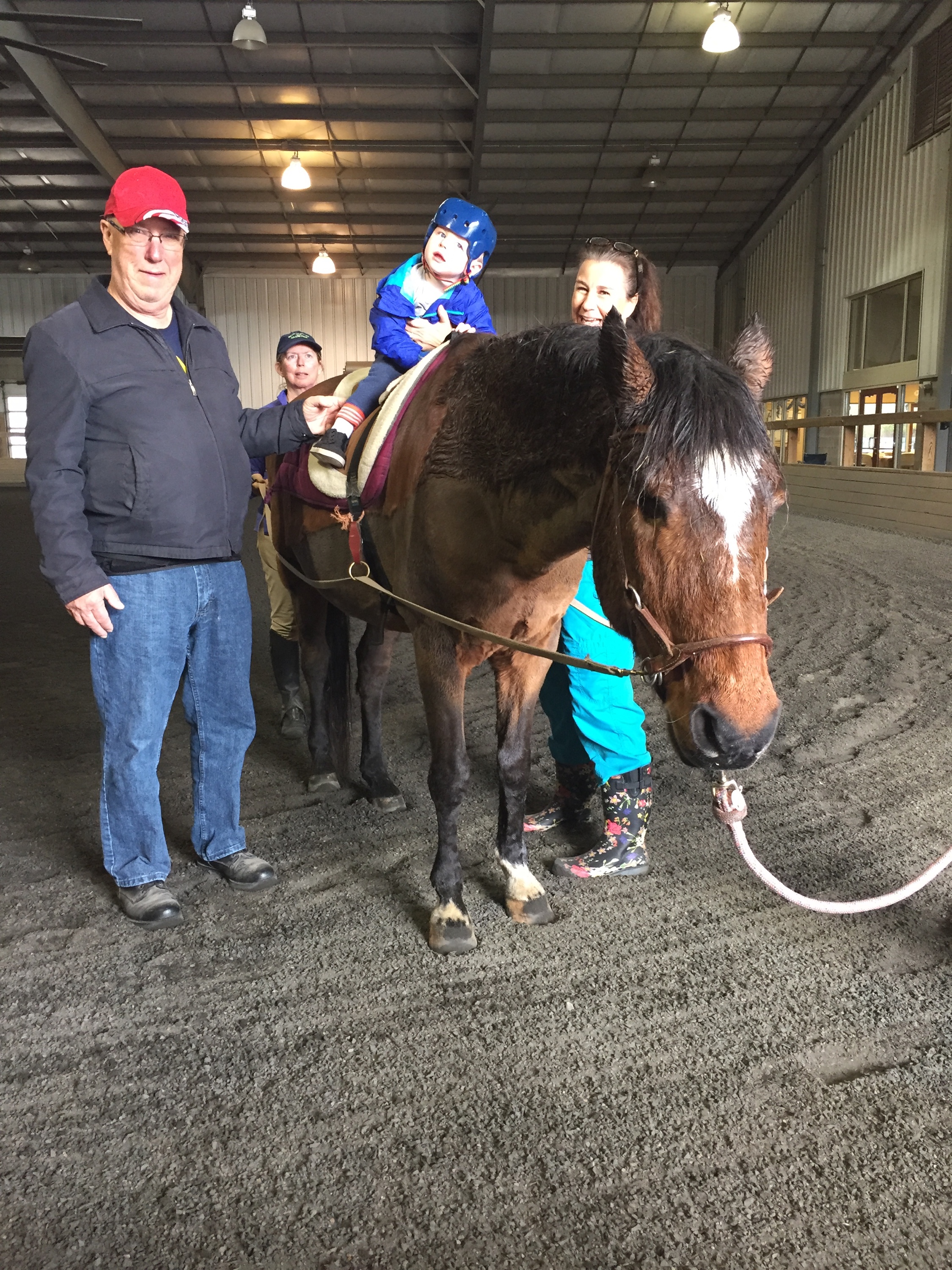
This week, Solly had his first ever PT intensive at Full Circle Therapy, the center where he does hippotherapy.
It was intense! (Seriously. Solly took a 4 hour nap yesterday!)
Each day started bright and early at 8am, which meant an even earlier wake up call than usual for Sol. Our goal for the week was to increase his mobility, so Jennifer, his PT, focused each day on activities to strengthen his hamstrings, hip flexors, glutes, and all walking muscles, as well as other activities to bring awareness to these parts of his body. She used a combination of weight-lifting via pulleys, a Spider Cage, mechanical horse, treadmill, swing, and therasuit to target his walking muscles and core, quickly moving to a new activity when Solly started to appear “over it” to keep him interested and engaged. She also tried having him walk in his various braces with his KidWalk, a gait trainer, crutches, and with hands under his arms for support, all trying to trigger and activate different muscles and so he wouldn’t get stuck in one pattern.
It was fascinating, exhausting, and, in the end, SUPER productive. We went from Sol really struggling on Monday to engage his flexors to walk forward on the treadmill to him walking on his knees and feet with assistance under his arms on Friday. We have a long way to go, but now we understand that Solly’s issues with walking stem from a motor planning issue – his legs get stuck in extension and his brain has trouble telling them to break up any high tone to bend the knee. Jennifer sent us home with three simple PT activities to focus on over the next few months and, because we see her every week for hippotherapy, she can check in on his progress and help us makes tweaks. We’ll focus on those activities for walking until the end of October, when we travel to Tampa for a 3 week Therasuit intensive.
We are so thankful to have found Jennifer. She is very in tune with Solly’s needs and thinks the sky is the limit for him. We couldn’t agree more.
Here are some photos taken throughout the week:
This slideshow requires JavaScript.
And my favorite video of reciprocal knee walking (!!!):
Even though one of Sol’s strokes completely wiped out his speech center, speech is one thing that I never worried about as much as I did gross and fine motor skill development. He’s always been behind in speech, especially expressive speech, but it’s one area where we continue to see gains, even if it’s just a new sound. Before Sol’s first birthday, I met with a neuro-developmental researcher who was studying speech development after stroke and much of her research found that if one area of the brain was damaged, its mirror would take over the skills typically assigned to that section of the brain. Because the right side of Solly’s brain had much more healthy brain tissue than the left, she assured me that the right side would likely rewire to house his speech.
To date, Solly has few consistent words other than “hi” “bye bye” and “dada”. He continues to experiment with new sounds, showing new control over his tongue, particularly after our recent hyperbaric oxygen therapy. Yet, because he has difficulty with motor control and has a hard time with sign language, we find it hard to know what he wants. His inability to communicate with us pushed us to want to find other means of communication, so when our developmental pediatrician suggested an Augmentative and Alternative Communication (AAC) device evaluation, we jumped at the opportunity.
Playing on the iPad. Easiest evalation ever!
Last Friday morning, Solly and I got up bright and early for an 8am evaluation at the Vanderbilt Bill Wilkerson Center. We met with a very sweet speech therapist who sat down and asked about Solly’s schedule, how he is communicating, what he likes to do the most, and what his gross and fine motor skills look like. She also asked about the speech therapy that we’d done in the past year and learned about our foray into AAC, which has consisted of a Big Mac button, a Twin Talks device, and communication via simple pictures. We also talked about the simple signs that Solly knows (“all done” and “more”) and the words he uses consistently.
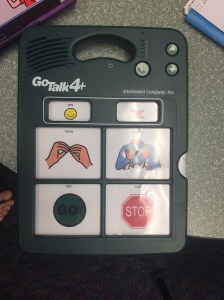
The GoTalk 4+
Then, for the next hour, the speech therapist played with Solly. They played music games on an iPad, worked with simple low tech communication devices, and high tech communication devices that looked very similar to an iPad. Afterwards, she explained to me that she was looking at how he used his hands to make selections on the devices, how he organized his motor skills to make those selections, and how he made selections when the device was placed on his left side versus his right side. Based on her findings, she suggested we start with a low tech communication device similar to the GoTalk 4+ or GoTalk 9+, thinking these would be a good way to start communicating with Solly until he’s ready for a more high tech device or until he’s able to speak on his own.
Next week, we start with a new speech therapist at High Hopes in Franklin. After we meet with her and set Solly’s goals, we’ll buy or borrow a low tech device and get started communicating (better) with our kiddo. We’re excited to see where this goes!
We had to make one of the hardest decisions yet for Solly recently. We opted for Solly to have a (non-invasive, preventative) surgery.
It was one of those decisions where I was constantly questioning myself, I felt others questioning my decision, and I didn’t have complete support from Solomon’s doctors. In other words, it was a completely agonizing decision. But, through the entire decision-making process, I felt my gut telling me that I was right, we were doing the right thing, and in the end, we had proof that we made the right decision.
Let me back up…
The Backstory & Consultation
Back in February, we were at an Anat Baniel Method intensive. Our practitioner asked us if we’d heard of the procedure ‘SPML’, thinking it could be something that might help Solly. She gave us the contact information for the two (!) doctors that perform the procedure in the United States and encouraged us to contact them to see if Solly might be a candidate.
We went home and did a little research and found out that ‘SPML’ stands for Selective Percutaneous Myofascial Lengthening. It’s a non-traditional, non-invasive procedure that releases the connective tissues surrounding the muscles. The surgeon uses what is essentially a needle to poke holes in the tissue. No cutting of muscles or ligaments is involved, so recovery is typically quick. (Click here for a more in depth conversation about SPML.) Mike and I saw before-and-after videos of children with stiff muscles who gained the ability to move freely after surgery. We knew Solly needed a chance of that same freedom of movement: a consultation with one of these doctors seemed like a no-brainer.
The two doctors who perform this procedure are Dr. Nuzzo in Summit, New Jersey and Dr. Yngve in Galveston, Texas. We chose to consult with Dr. Nuzzo because he was the one who developed this procedure as well as several other preventative surgeries to help children with cerebral palsy. We sent in the required spine and hip x-rays as well as a few videos to show Solly’s range of motion and movement patterns. Here’s one video that shows the level of tightness in Solly’s legs:
Within the week, we received a response directly from Dr. Nuzzo, who said that not only was Solly “mummy bound” and “in paralytic jail”, but the tightness in his legs was pulling his left hip out of the socket, potentially damaging the left hip socket. He recommended quick action to avoid further dislocation, suggesting that we not only do SPML to get him out of paralytic jail, but also do an additional surgery called SLOB (Supero Lateral Outcropping Bone-graft) which would essentially extend his hip socket to keep the ball of the hip in place. It was a more invasive surgery than SPML and recovery would include several months in a custom, removable hip brace. (Another Mom has written extensively about her daughter’s SLOB procedure, which you can read here.)
At only 7 months old, Solly’s left leg was already pulling inwards and scissoring
Neither suggestion surprised us. In fact, we’d noticed Solly’s left leg scissoring since he was only a few months old. In recent days, even with the improvements we saw with HBOT, Solly’s legs had been getting tighter and tighter, and with our developmental pediatrician, we’ve been monitoring his left hip over the past year. Both of these developments – spasticity and hip dysplasia – are very common in children with cerebral palsy. The traditional treatment plan includes ongoing botox injections to loosen the muscles – these injections typically only last 3 months and can be painful to get – until therapy develops correct movement patterns to stabilize the hip or until a very invasive VRO (Hip Varus Osteotomy) surgery is needed. The VRO is a nasty surgery where the leg bone is cut and repositioned into the hip socket. Recovery includes an almost full body cast for 8+ weeks and because the surgery actually shortens the leg, often both legs are done at the same time. Recovery is long and painful. This is something we never want Solly to have to go through.
Dr. Nuzzo’s approach not only prevents the need for VRO surgery, but it can increase range of motion and give children a chance to develop better movement patterns so future surgical intervention is at a minimum. While Solly’s doctors wanted him on the path of Botox injections and eventual VRO surgery, we opted to follow Dr. Nuzzo’s advice and scheduled him for SPML and SLOB surgery on June 6th.
The Surgery
A mere week after we came home from Solly’s HBOT treatments, Mike, Solly, Bea, and I boarded a plane for New Jersey where we planned to reside for 9 days. We had a pre-operative appointment scheduled for the day before surgery and expected Solly to remain in the hospital for 3 to 5 days after the procedure to recover. Though we were nervous to have this procedure done, when we met Dr. Nuzzo in person, those nerves quickly subsided as we met a very optimistic doctor whose philosophy was to do as much preventative work as possible for children with cerebral palsy.
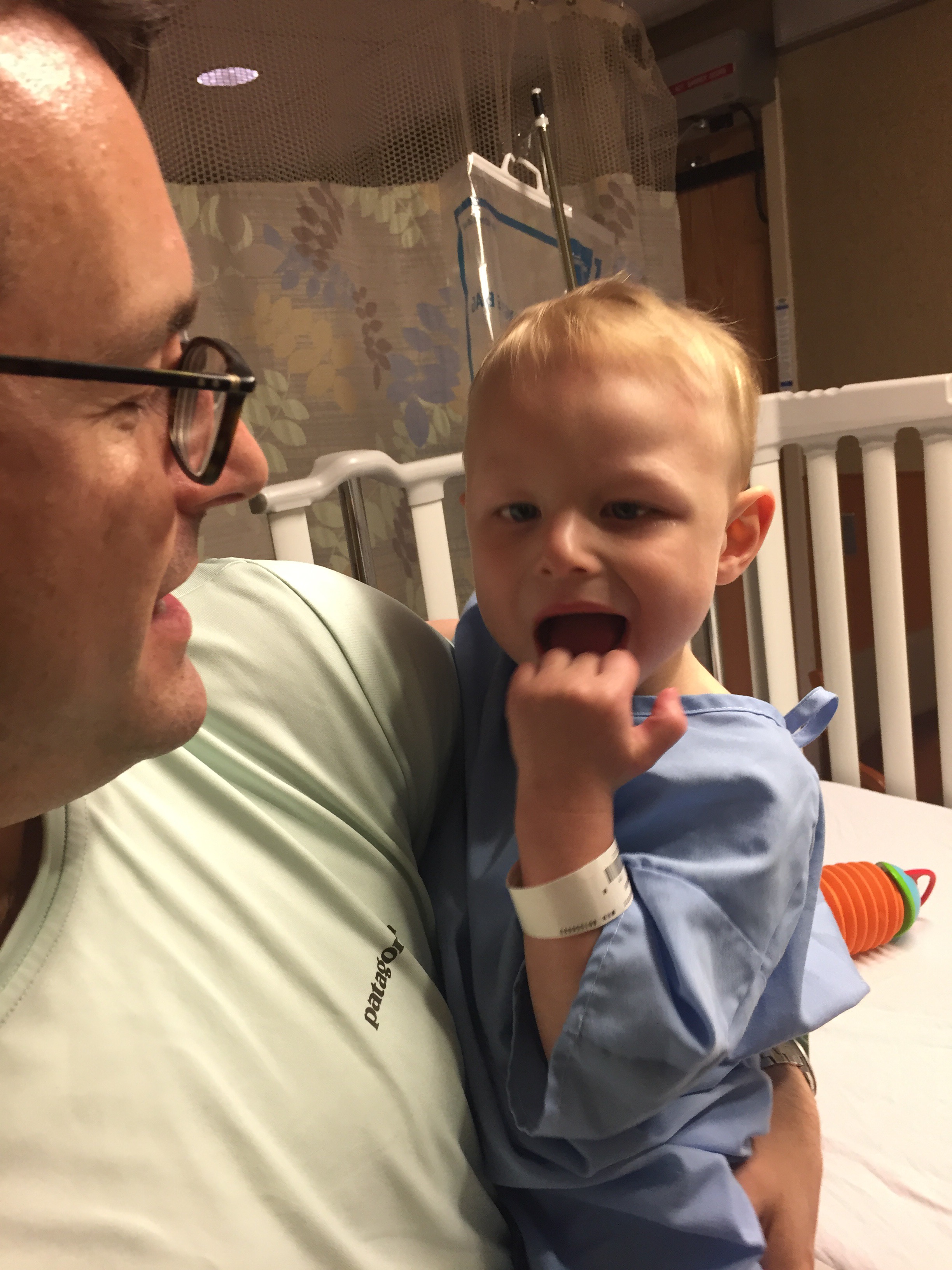
Snuggling with Dad in the pre-op area
On June 6th, Solly’s surgery was set for 1pm. After we were escorted back to the pre-op area, Dr. Nuzzo met us and explained that once Solly was under anesthesia, he would do a series of x-rays to confirm his hip position and then perform the SPML procedure. After that, he would take another set of x-rays to see how SPML affected his hips before proceeding onto SLOB. The combined procedures were expected to take about 3 hours, but Dr. Nuzzo advised us to stick around incase he needed to give us any updates. I carried Sol to the operating room where a team of nurses and the anesthesiologist were waiting, and I was able to hold his hand and talk to him while the anesthesiologist put him under.
Then it was a waiting game.
Mike ran back to the hotel to check on Bea who was getting in some quality time with Mike’s parents. (Thank you Bebe and Gramps for flying up to help us!) I stayed in the hospital waiting room and after what seemed like two million years – but was probably only about 45 minutes – the nurse overseeing the waiting area called me up to her desk. Dr. Nuzzo was on the phone.
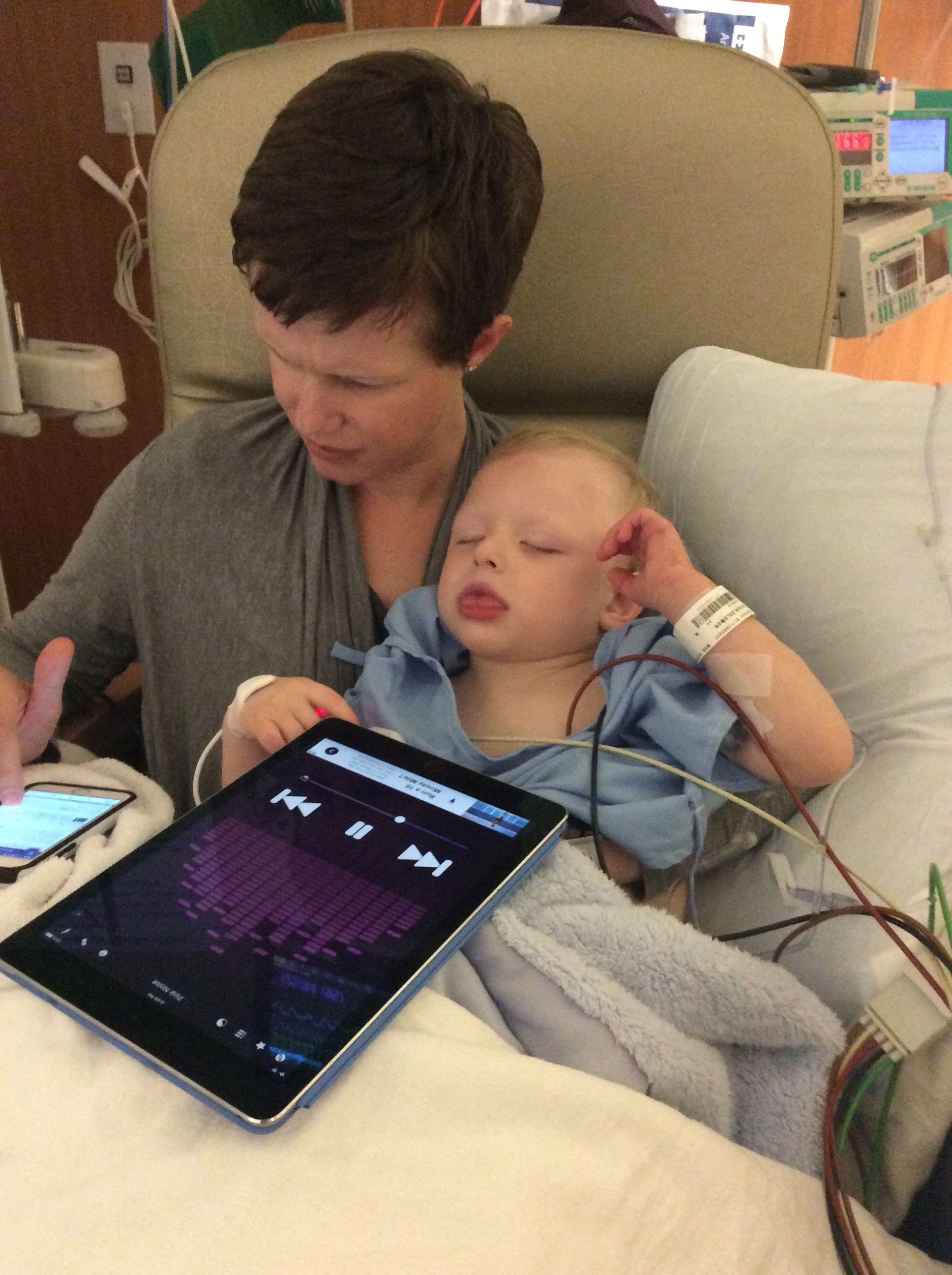
Struggling to wake up from the anesthesia
He said to me, “Well, this is unexpected, but I did the SPML procedure, and Solly’s hip popped back into place. It’s in there snug enough that I’d like to stop here, try putting him in a brace for a few months, and see if we can’t get it to stay there without further surgical intervention.”
Holy cow, we were ecstatic! We hadn’t even considered this possibility and were thrilled that Sol didn’t need an invasive surgery.
The Aftermath
Once we got home, we didn’t push Sol to do any physical therapy for a couple of weeks while he recovered. At Dr. Nuzzo’s suggestion, we got him into hippotherapy and focused our efforts there as well as in ABM intensives.
We are now 5 weeks past the surgery, and the results have been better than we could have ever imagined. Before surgery, Sol couldn’t stand at all, let alone take steps. If we were to put him in his walker, his legs would stiffen to the point where it was hard for us to move them. We had started to lose hope that we could find a way to help him. Now, when in his AFOs and hip brace, Solly can stand and balance himself as he holds on to something. Here’s a short video of him standing in a train at the zoo, taken just a couple of weeks after surgery:
And in the past ten days or so, he even started taking steps in his KidWalk walker:
Next, we’ll take him to a weeklong Therasuit Intensive Therapy at the Full Circle Therapy Center. We hope this therapy will continue to help him recover and thrive after SPML.
For those of you who have been following our blog since the beginning, you might remember my constant worry over Solly’s vision. Sol was born with his eyes somewhat stuck looking towards the left. A part of the initial prognosis given was that he could be blind. (Note to Mom’s new to a pediatric stroke diagnosis: take the first prognosis, however grim it may be, and consider it only a possible outcome. Your child CAN and most likely WILL do much more than doctors believe he or she will after a stroke.) Even after rigorous vision therapy, we still got diagnoses – from several different doctors, many giving conflicting thoughts – of delayed visual maturation, CVI (cortical vision impairment), strabismus, nystagmus, possible visual field cut, possible double vision, and so on. With all these possible diagnoses swirling around us, even though it seemed that Solly was compensating well for whatever vision issues he had, we couldn’t be sure how well he was seeing. It was always a point of major frustration.
With hyperbaric oxygen therapy (HBOT), we had read of many children having improved vision after a full course of treatment. In our own experience, we saw many instances where Solly was interacting with his surrounding environment in ways we’ve never seen before, thinking that maybe it helped his vision and helped his brain make new connections as a result. But whenever we think Solly is interacting in new ways, we question IF he is and WHAT, if anything, helped his brain make those connections. We try so many things that we can’t always be sure what move was the right one.
However, after an appointment with Sol’s developmental optometrist earlier this week, we are no longer questioning these new connections: HBOT did, in fact, help Solly’s vision.
Amusing ourselves at an early morning optometry appointment
This past October, at our last appointment with our optometrist, he ran a test on Sol where he set up sensors on his head and had Solly watch a series of images flash on a screen. The sensors provided data into what Solly was seeing and how well his brain was processing the images. We were delighted when the results came back as “within normal limits.”
This week, we saw the same doctor for the first time since October and he ran the same test. After he examined Solly’s eyes, he told me that his vision had improved even more in the past 8 months. He asked if we’d been working hard on our home vision therapy exercises. I said, no, we simply just try to expose Solly to as many new environments as we can, but that we’d also done a full treatment of HBOT and thought that had a great impact on his vision. His optometrist not only agreed that HBOT had helped but he also encouraged us to do another round of treatment as our schedules allowed. We will continue to be followed by Solly’s optometrist every 6 months, but right now, no need to worry about glasses, patching, or surgery at this point.
Three weeks ago, Solly had his first hippotherapy session. Ever since Solly turned two, the age when children are generally allowed to start horse therapy, I have been anxious to get him on a horse.
In December, he had an evaluation at Saddle Up!, a therapeutic riding center in nearby Franklin. In the short 20 minute evaluation, I got a clear picture of how beneficial hippotherapy could be for him: he smiled and giggled while on horseback as the horse moved at a walk, halted, and circled. Though it may not seem like those simple actions are doing much, they are, in fact, building much-needed core strength, balance, and movement patterns in Solly’s body and brain. Unfortunately, at the time of our evaluation, Saddle Up! was undergoing some therapy staff changes and as much as the physical therapist who completed Solly’s evaluation wanted to begin treating him, there simply wasn’t a spot for him and he was placed on the waiting list. Surprisingly, there are only two therapeutic riding centers in Nashville: Saddle Up! in Franklin is a quick 20 minute drive and Full Circle Therapy in Smyrna is a much father trek. I preferred to not spend too much time driving to and from therapy appointments so I considered Saddle Up! our only option.
Solly’s evaluation at Saddle Up!
Fast forward six months, in the recovery room for Solly’s SPML surgery, his orthopedic surgeon told us the best way for his hips to rebound and strengthen after surgery is to think of putting him on a horse. I’m sure he meant this figuratively – creating a horse shape between his legs, especially any time he is out of his brace. For those of you who know me personally know that I’ve always been a horse-crazy nut, so a light went off in my head as the doctor said this and I took him quite literally – it was time to get Solly on a horse! I decided extra time in the car was worth the benefits of this type of therapy, so I got in touch with Full Circle Therapy. Days later, we completed Solly’s evaluation and were able to find a spot on his new therapist Jennifer’s hippotherapy calendar. We started immediately.
We are now three therapy treatments in and we’ve have already seen some benefits. I cannot wait to see how Solly continues to thrive with his weekly riding therapy and hear both his and Bea’s giggles when they both get to see Solly’s therapy pony each week.



 Sol the Man