What A Ham

After Solly was born, we had a month-long stay at the Georgetown University Hospital’s NICU. There, the neonatologist had told us that in order to be discharged, we had to get Sol’s seizures under control and come up with solutions for his oxygen levels and feeding. Seizures were the easiest thing to get under control, followed by removal of all oxygen support. While we were confident that Sol would come home without any feeding support, some of his doctors were less-than-optimistic. I remember expressing some feeding concerns to one of his rounding doctors, a Fellow who was spending some time at Georgetown, and her exact words to me were: “I don’t think he’ll ever eat by mouth. He may be able to have some pleasure feedings by mouth, but he’ll probably go home with a g-tube.”

Less-than-optimistic, right? It was definitely not the kind of thing we wanted to hear.

Luckily, Solly is stubborn (just like his Mama and Dada!) and proved that doctor wrong, leaving the NICU a little over a week later without any feeding support.

However, since leaving the NICU, feeding has continued to be a struggle for us. Sol’s strokes affected his ability to coordinate muscles, including facial muscles, as well as dampened some of his sensory abilities. At three years old, he is still taking the majority of his calories in by bottle and eating some finger foods, but primarily favoring purées that he can eat by spoon or feed to himself with his fingers. We’ve been in weekly feeding therapy since he was one year old to address his muscular challenges as well as a few behavior issues. Progress has been slow, but entirely worth it, especially after we switched to a new, very experienced feeding therapist, Linda, at High Hopes in Franklin, TN.
Continue reading

The Right Kind of Support

Before I had Solly in my life, social media was a place to simply share photos, articles, humblebrag, and occasionally whine. Back then, even though I was working in digital marketing, I felt myself growing increasingly annoyed with all the oversharing on all platforms and was particularly ready to pull the plug on Facebook (hello, addiction!).

Then, I had a special needs child. Because of HIPPA, our doctors and therapists couldn’t connect me with other parents going through a similar journey. I connected with a few parents while in waiting rooms, but their child’s diagnosis wasn’t always the same, so I still had questions and craved advice from parents who had been there, done that. So, I started googling and realized how many special needs parents were making those kinds of connections on social media – mostly, Facebook, but also Instagram and Twitter. Over the past three years, I’ve started one support group and have followed and participated in several others. These groups not only help me discover new therapies, new medical treatments, and doctors that can help Solly, but they also give me a place to vent and share wins with people who go through similar ups and downs every day. Plus, I’ve even gotten to meet several local parents who I’ve since met up with in person! (These meet ups are refreshing – it’s always like reconnecting with a long-lost friend.)

A daily walk in the shoes of a special needs parent is certainly not an easy one. But I’ve found that with the right support group, life has gotten a little less scary and, in most cases, I’ve even felt empowered when making decisions for Solly.

If you’re new to a cerebral palsy or stroke diagnosis, or you’re simply looking for help with some of the alternative therapies, here’s a list of my go-to support groups on Facebook:

General

KISS Pediatric Stroke Support (I started this support group with two other stroke Mamas so we could not only connect parents with one another and share experiences, but so we could also follow what non-profits were doing to advance pediatric stroke awareness. We’ve grown to over 1,000 members and have parents from all over the world.)
Mom’s of Pediatric Stroke Survivors (If you’re local to the middle Tennessee area, be sure to join this one. It’s based in Nashville and gives lots of good resources on local therapies and doctors, plus the Mama who started it puts together a meet up every few months.)
CP Warriors, Mommies, Daddies, Grandparents, and Caregivers
2014 Cerebral Palsy Babies Support

Medical & Alternative Procedures

SPML – Selective Percutaneous Myofascial Lengthening
HBOT for Pediatric Neurological Conditions
Parents for HBOT
Stem Cell Therapy for Cerebral Palsy and Brain Injury (Parents Information)
Pediatric Cannabis for CP & Other NeuroMuscular Disorders
Pediatric Cannabis Therapy
Anat Baniel Method Parents/Caregivers

Know of any others I should add to the list? Feel free to send them my way!

As I mentioned above, I’ve also met some parents and gotten great info on other social media platforms. I’ll do my best to put together a post with my favorites, so if Facebook isn’t your thing, stay tuned!

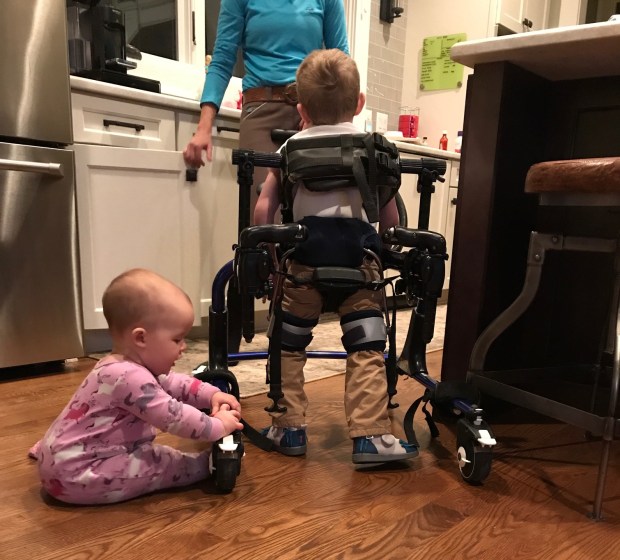
Solly and Bea

Another type of support often seen in our house: sister helping brother!

An Intense Intensive

This week, Solly had his first ever PT intensive at Full Circle Therapy, the center where he does hippotherapy.

It was intense! (Seriously. Solly took a 4 hour nap yesterday!)

Each day started bright and early at 8am, which meant an even earlier wake up call than usual for Sol. Our goal for the week was to increase his mobility, so Jennifer, his PT, focused each day on activities to strengthen his hamstrings, hip flexors, glutes, and all walking muscles, as well as other activities to bring awareness to these parts of his body. She used a combination of weight-lifting via pulleys, a Spider Cage, mechanical horse, treadmill, swing, and therasuit to target his walking muscles and core, quickly moving to a new activity when Solly started to appear “over it” to keep him interested and engaged. She also tried having him walk in his various braces with his KidWalk, a gait trainer, crutches, and with hands under his arms for support, all trying to trigger and activate different muscles and so he wouldn’t get stuck in one pattern.

It was fascinating, exhausting, and, in the end, SUPER productive. We went from Sol really struggling on Monday to engage his flexors to walk forward on the treadmill to him walking on his knees and feet with assistance under his arms on Friday. We have a long way to go, but now we understand that Solly’s issues with walking stem from a motor planning issue – his legs get stuck in extension and his brain has trouble telling them to break up any high tone to bend the knee. Jennifer sent us home with three simple PT activities to focus on over the next few months and, because we see her every week for hippotherapy, she can check in on his progress and help us makes tweaks. We’ll focus on those activities for walking until the end of October, when we travel to Tampa for a 3 week Therasuit intensive.

We are so thankful to have found Jennifer. She is very in tune with Solly’s needs and thinks the sky is the limit for him. We couldn’t agree more.

Here are some photos taken throughout the week:

This slideshow requires JavaScript.

And my favorite video of reciprocal knee walking (!!!):

Augmentative and Alternative Communication

Even though one of Sol’s strokes completely wiped out his speech center, speech is one thing that I never worried about as much as I did gross and fine motor skill development. He’s always been behind in speech, especially expressive speech, but it’s one area where we continue to see gains, even if it’s just a new sound. Before Sol’s first birthday, I met with a neuro-developmental researcher who was studying speech development after stroke and much of her research found that if one area of the brain was damaged, its mirror would take over the skills typically assigned to that section of the brain. Because the right side of Solly’s brain had much more healthy brain tissue than the left, she assured me that the right side would likely rewire to house his speech.

To date, Solly has few consistent words other than “hi” “bye bye” and “dada”. He continues to experiment with new sounds, showing new control over his tongue, particularly after our recent hyperbaric oxygen therapy. Yet, because he has difficulty with motor control and has a hard time with sign language, we find it hard to know what he wants. His inability to communicate with us pushed us to want to find other means of communication, so when our developmental pediatrician suggested an Augmentative and Alternative Communication (AAC) device evaluation, we jumped at the opportunity.

img_4267

Playing on the iPad. Easiest evalation ever!

Last Friday morning, Solly and I got up bright and early for an 8am evaluation at the Vanderbilt Bill Wilkerson Center. We met with a very sweet speech therapist who sat down and asked about Solly’s schedule, how he is communicating, what he likes to do the most, and what his gross and fine motor skills look like. She also asked about the speech therapy that we’d done in the past year and learned about our foray into AAC, which has consisted of a Big Mac button, a Twin Talks device, and communication via simple pictures. We also talked about the simple signs that Solly knows (“all done” and “more”) and the words he uses consistently.


img_4264

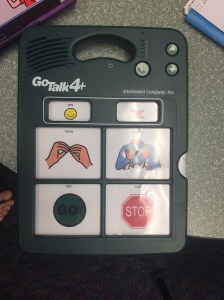
The GoTalk 4+

Then, for the next hour, the speech therapist played with Solly. They played music games on an iPad, worked with simple low tech communication devices, and high tech communication devices that looked very similar to an iPad. Afterwards, she explained to me that she was looking at how he used his hands to make selections on the devices, how he organized his motor skills to make those selections, and how he made selections when the device was placed on his left side versus his right side. Based on her findings, she suggested we start with a low tech communication device similar to the GoTalk 4+ or GoTalk 9+, thinking these would be a good way to start communicating with Solly until he’s ready for a more high tech device or until he’s able to speak on his own.

Next week, we start with a new speech therapist at High Hopes in Franklin. After we meet with her and set Solly’s goals, we’ll buy or borrow a low tech device and get started communicating (better) with our kiddo. We’re excited to see where this goes!